Sony’s Reon Pocket line is being refined with a clear priority: making the wearable more comfortable for all-day use, especially for people who move around outdoors. In hot weather and high-mobility situations, that approach gives the device a stronger case as a personal cooling solution rather than a replacement for conventional air conditioning.
The appeal of Reon Pocket lies in how directly it works. Instead of cooling an entire room, the device delivers a localized cooling sensation to the body in a compact form that can stay hidden under clothing.
A wearable built for direct body cooling
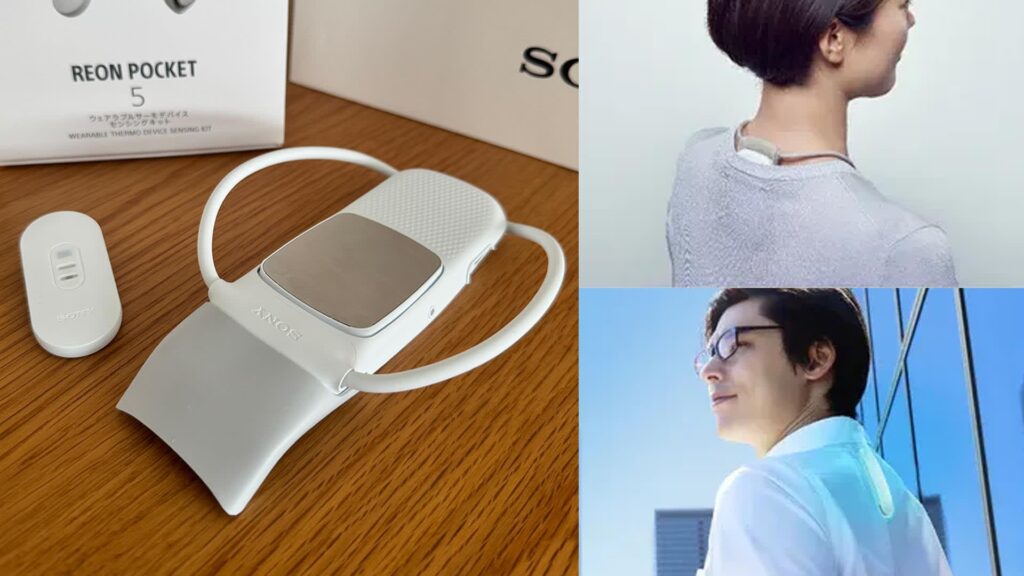
Reon Pocket is worn on the body and works in a much more personal way than a standard AC unit. It is designed to sit in a special attachment placed behind clothing, with its main cooling area around the neck or back.
That placement matters because it helps users feel the effect where it is needed most. People can keep moving, commuting, or spending time outdoors without relying on a cooled room to stay comfortable.
Sony has continued to update the series so the performance keeps improving. On the newer generation, names such as Reon Pocket Pro Plus and Reon Pocket 5 have appeared with a range of enhancements over earlier models.
The focus of those updates is not only stronger cooling efficiency. Sony is also clearly working on comfort during long wear, which is essential for a device meant to stay on the body throughout the day.
Lighter form, easier movement
One of Reon Pocket’s main strengths is its compact and ergonomic design. The materials are intended to avoid interfering with the user’s movement, which supports its role as a wearable for active routines.
Because of its minimal shape, the device can remain discreet under clothing. That makes it more suitable for users who want practical functionality without a visibly bulky accessory.
Ease of control is another part of the experience. Users can adjust temperature levels through a companion app on a smartphone, giving them a more personal setup than conventional cooling equipment.
That kind of control helps the device adapt to changing conditions. It also reinforces the idea that Reon Pocket is meant for modern daily use, where comfort needs can shift depending on the environment and activity.
More than cooling alone
Some of the newer models are not limited to cooling. They also support a heating mode for cold weather, which broadens the device’s usefulness beyond summer conditions.
This wider function shows that Sony is pushing Reon Pocket beyond the idea of a simple portable cooler. The device is being positioned as a versatile wearable that can support body comfort in different situations.
The direction also reflects a broader shift in wearables. Devices that were once associated mainly with smartwatches or smart earphones are now moving closer to physical comfort and everyday usability.
A category with growing relevance
Wearable products based on body cooling have gained more attention in recent years. Rising temperatures and extreme heat have encouraged more companies to explore solutions that help users deal with harsher outdoor conditions.
In that environment, Sony has an advantage because it has already invested seriously in the category. Its electronics background also gives the company a strong foundation for maintaining quality and continuing development.
Reon Pocket is increasingly seen as a practical answer for urban heat. It reduces the need to carry large devices or depend entirely on air-conditioned spaces while moving through daily routines.
The broader concept is straightforward: technology is no longer only about notifications or entertainment. In Reon Pocket’s case, it is used to help the body stay comfortable in conditions that are otherwise difficult to endure.
With updates centered on efficiency, ergonomic comfort, and flexible use, Reon Pocket stands out as one of the most unusual wearable devices in its class. It also shows that wearable innovation can still expand into new forms when the goal is everyday comfort and mobility.