Google is turning Search into something much closer to an active digital assistant than a static search box. The latest changes push it beyond simple links and autocomplete, toward a system that can understand context, carry conversations forward, and even work on tasks in the background.
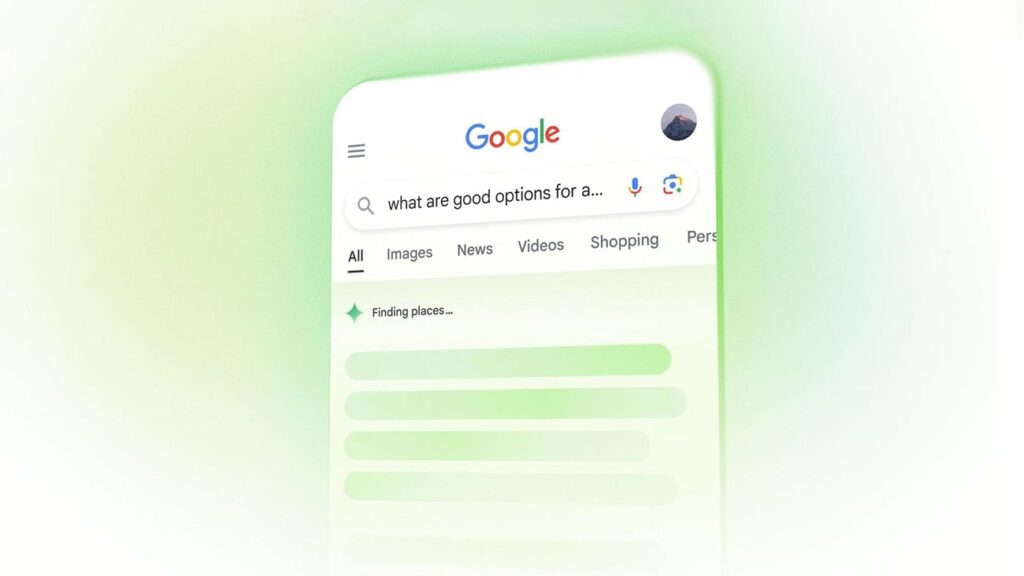
The most visible shift starts with the main search box, which Google says has received its biggest global update. Instead of only predicting the next word, it now offers broader AI-assisted suggestions and helps users shape more precise questions from the beginning.
Search becomes more flexible at the point of entry
Google is also widening the kinds of inputs Search can accept. Users can now start or enrich a search with files, text, images, videos, and Chrome tabs.
That makes the search experience less dependent on typed keywords alone. At the same time, Google is keeping traditional result types in place, so the classic Search experience is not being removed.
AI Overviews and AI Mode are blending more closely
Another important change is the tighter connection between AI Overviews and AI Mode. When users move from an AI Overview into AI Mode, the original context stays intact, which allows the exchange to continue without starting over.
Google is rolling out this AI Mode experience within AI Overviews globally on web and mobile. The result is a search flow that feels more continuous, with AI following the user’s intent instead of delivering a one-off summary.
Personal signals and broader availability
Google is also expanding Personal Intelligence in AI Mode to more regions and languages. For now, the feature is limited to Gmail and Google Photos, while Calendar support is said to be coming soon.
This points to a more personal version of Search, where responses can become more relevant by drawing on connected Google services. The approach goes beyond general answers and moves toward context-aware assistance tied to user data.
Search is starting to behave like an agent
Google’s next step is even more ambitious. Starting in the summer, Search will gain agentic capabilities through a feature called information agents, which are designed to monitor the web and fresh data continuously based on a user’s specific question or need.
Google says these agents will track blog posts, news sites, social posts, and live data such as real-time information on finance, shopping, and sports. The goal is to watch for changes that matter directly to the user’s query.
In practical terms, the feature works much like a far smarter Google Alerts. A user can type one or two sentences, then let the agent keep running in the background to monitor things like the price of consumer electronics or property market movements in a certain area.
Access will not be open to everyone. Google says information agents will arrive in the summer for Google AI Pro and Ultra subscribers only.
Bookings and local tasks are expanding too
Google is also widening agentic booking inside Search. The feature now reaches local experiences and services, moving beyond the narrower booking scenarios it supported before.
For categories such as home repairs, beauty, or pet care, Google will even call the relevant business to schedule an appointment on the user’s behalf. This expansion is set to arrive in the US in the summer.
That shift shows how Search is being positioned less as a discovery tool and more as a service layer that can help finish real-world tasks. It is a notable move from finding information toward handling practical actions directly.
Visual explanations and mini apps
Search is also gaining agentic coding capabilities that generate visuals such as graphs, charts, simulations, and tables from a user’s query. These outputs are meant to make complex topics easier to understand, especially in science and technology.
Google gave examples such as a visual explanation of how a diesel engine works, along with other technical questions that are better answered through graphical representation. The visual explanation feature will begin rolling out in the summer and will be free for everyone.
Agentic coding will also unlock mini apps. These small applications can be built for very specific needs, such as tracking daily calorie intake or other self-improvement goals.
With mini apps, users can create functional trackers or dashboards to monitor progress. Google says this feature is planned for release in the coming months for Google AI Pro and Ultra subscribers.
Taken together, these updates show a clear direction for Search. Google is reshaping it into a system that can understand intent, preserve context, monitor change, create visuals, and help complete tasks from a single entry point.
Source: www.androidpolice.com