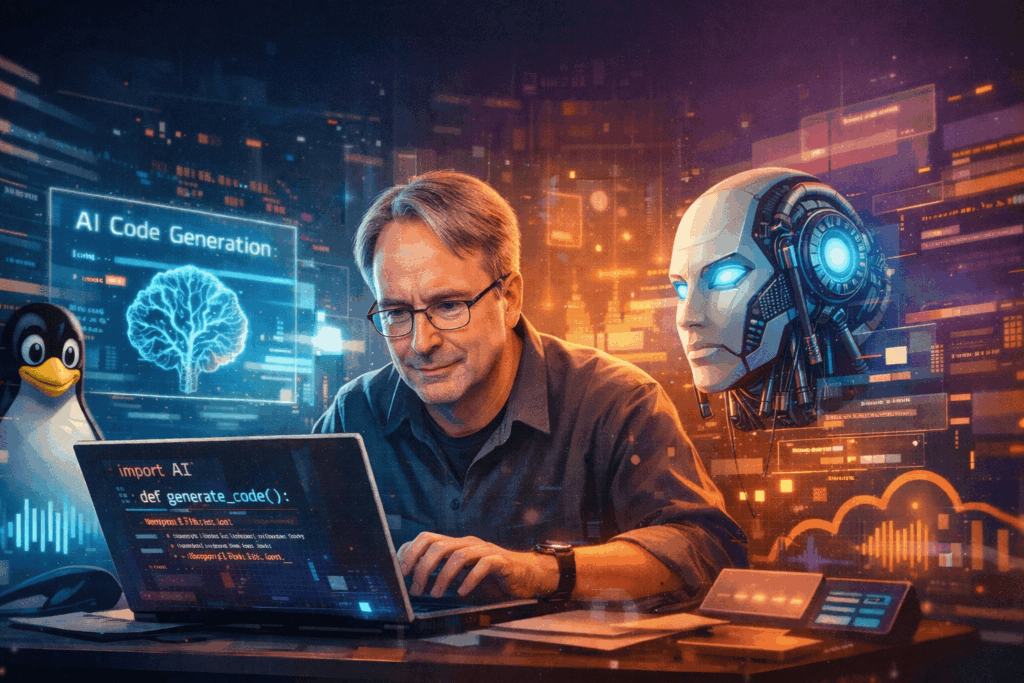
The debate over AI-written code is drawing sharper lines inside software development, and Linus Torvalds is not impressed by the idea that machines can now do nearly everything. The Linux creator said he was “really angry” after hearing claims that 99 percent of some codebases were written by AI.
His criticism lands at a moment when tools such as Claude Code from Anthropic and Codex from OpenAI are becoming more common. That spread has helped normalize so-called vibe coding, where programming work becomes increasingly automated through AI assistance.
Torvalds does not deny that the technology is changing how programmers work. What he rejects is the idea that AI can replace the human understanding that still underpins usable software.
AI can help, but fundamentals still matter
In Torvalds’ view, AI is changing programming, but it is not changing the basic rules behind it. He said he is “100 percent sure” that AI is transforming the field, while insisting that the fundamentals remain the same.
That is why he argues programmers still need a solid grasp of the basics. AI may speed up work, but technical understanding remains essential if code is meant to function properly and be maintained over time.
He compared the effect of AI with the arrival of compilers in earlier eras of software development. Just as compilers converted human-readable code into machine-readable binary and helped raise efficiency, he sees AI as another tool layer that can boost productivity without replacing core knowledge.
The danger is not prompt-writing alone
Torvalds also pushed back on the assumption that success with AI coding tools depends mainly on writing clever prompts. In his view, that mindset becomes risky when developers do not truly understand what the model produces.
He stressed that programmers must understand both the instructions they give and the output they receive. That matters because generated code still needs to be readable, testable, and maintainable in the long run.
He also acknowledged a practical benefit: AI lowers the barrier for newer programmers. More people can now contribute, including to Linux, with AI support helping them write code.
But Torvalds made it clear that easier access does not remove responsibility. Code produced with AI still has to be understood, checked, and maintained by the humans using it.
A broader industry argument over quality
Torvalds’ comments arrive as large companies become more open about how much code is being produced with AI assistance. Anthropic is among the firms saying AI now writes nearly all of their code, while Meta and Amazon are also pushing harder into AI investment.
That backdrop has turned AI coding into more than a productivity story. It has become a question of software quality, long-term maintenance, and whether developers still understand the systems they are building.
Torvalds carries particular weight in that debate. He created Linux in 1991, and the open-source system remains widely used by programmers and dominates many web servers and supercomputers around the world.
He is not the only prominent developer raising concerns. Bjarne Stroustrup, the creator of C++, recently said AI-generated code is so poor that it is driving some developers toward retirement rather than forcing them to deal with it.
The wider argument is no longer about whether AI can save time. It is about how far automation should go before it starts to weaken the discipline required to write reliable software.
For Torvalds, the boundary is clear. AI can accelerate work and make coding more accessible, but the responsibility for the code still belongs to the person who uses it.
Source: www.indiatoday.in