China’s latest crewed mission to Tiangong is drawing attention not just for what it delivered, but for how quickly it reached its destination. Three astronauts aboard Shenzhou-23 completed an automatic docking with the space station just 3.5 hours after liftoff, underscoring how streamlined China’s human spaceflight operations have become in low Earth orbit.
The docking was completed at 2:45 a.m. Beijing time on Monday, May 25, 2026. After the hatch opened, the Shenzhou-23 crew entered the Tianhe core module and joined the Shenzhou-21 team already on board.
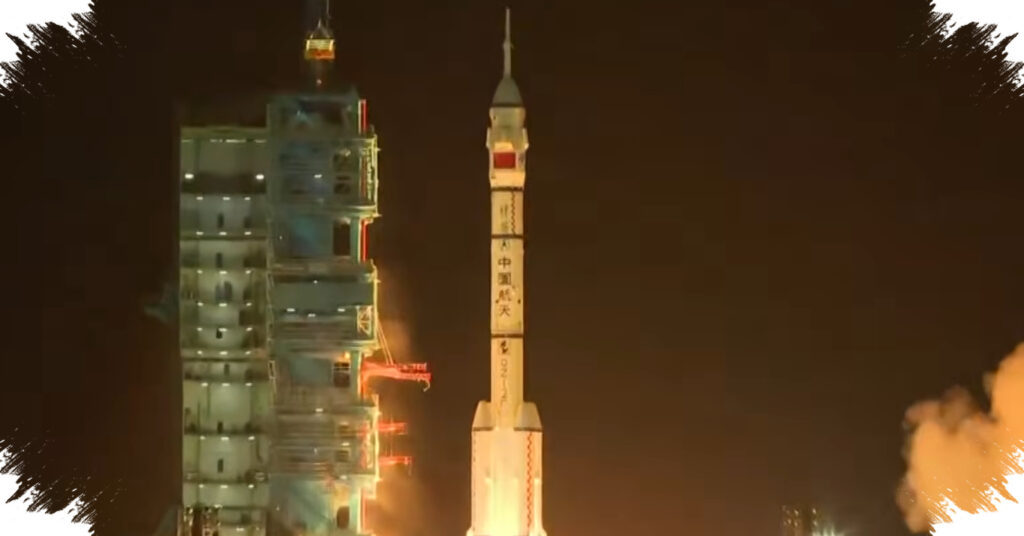
Shenzhou-23 lifted off from the Jiuquan Satellite Launch Center at 11:08 p.m. CST on May 24, 2026. A Long March 2F rocket carried the spacecraft from the Gobi Desert before it executed a rapid automated rendezvous and docking at the nadir port of Tianhe.
That quick sequence has become a hallmark of China’s crewed space program. The speed of the flight-to-station transition highlights more mature procedures, tighter coordination, and a growing level of confidence in operations around Tiangong.
The mission also marks the 16th official flight in China’s crewed spaceflight program. On board are Commander Zhu Yangzhu, pilot Zhang Zhiyuan, and payload specialist Li Jiaying, who begin a six-month stay as part of Tiangong’s regular crew rotation.
A station built around steady crew exchange
Tiangong now depends on a continuous rhythm of crew changes to stay active, maintained, and operated. Shenzhou spacecraft have become the main transport system for taikonauts assigned to the station, which China uses as a permanent three-module outpost.
In that context, the arrival of Shenzhou-23 is more than a routine handover. It reflects how the station is being supported through orderly rotations that keep human presence in orbit consistent over time.
The term taikonaut refers to Chinese astronauts, a label often used in Western media to distinguish them from American astronauts or Russian cosmonauts. The Shenzhou spacecraft itself was originally derived from Russian Soyuz technology, but it has since been extensively modernized and enlarged.
A longer test hidden inside a standard mission
Beyond the six-month rotation, the mission carries a more ambitious objective. The China Manned Space Agency has designated Shenzhou-23 as part of the first full one-year crewed spaceflight experiment.
One astronaut will remain in orbit for 12 months to gather data on how the human body adapts over extended periods in space. That information is considered important for understanding the effects of long-duration flight on biology.
The mission therefore serves two purposes at once. It supports the regular operation of Tiangong while also extending China’s research into the physiological demands of very long stays in orbit.
Part of a program that has climbed step by step
China’s crewed space program has advanced through a series of carefully tested milestones. The early uncrewed Shenzhou 1 to Shenzhou 4 missions, flown from 1999 to 2002, were used to validate launch systems, orbital operations, and automatic reentry capability.
A major breakthrough came with Shenzhou 5 in 2003, when Yang Liwei became China’s first astronaut in space. That flight made China the third country able to send humans into orbit independently.
The program expanded quickly between 2005 and 2016. Shenzhou 7 included China’s first spacewalk, while later missions demonstrated automatic docking with the Tiangong-1 and Tiangong-2 space labs.
Since 2021, the focus has shifted to Tiangong itself and to sustained human presence in orbit. Six-month crew rotations have become the defining pattern of station operations, and Shenzhou-23 adds another data point to a system that now supports both routine maintenance and more demanding research goals.
The mission is also seen as an important operational test for China’s planned crewed lunar landing target in 2030. For that reason, the quick launch, automatic docking, and smooth crew transition carry significance well beyond a single visit to Tiangong.
Source: sundayguardianlive.com