


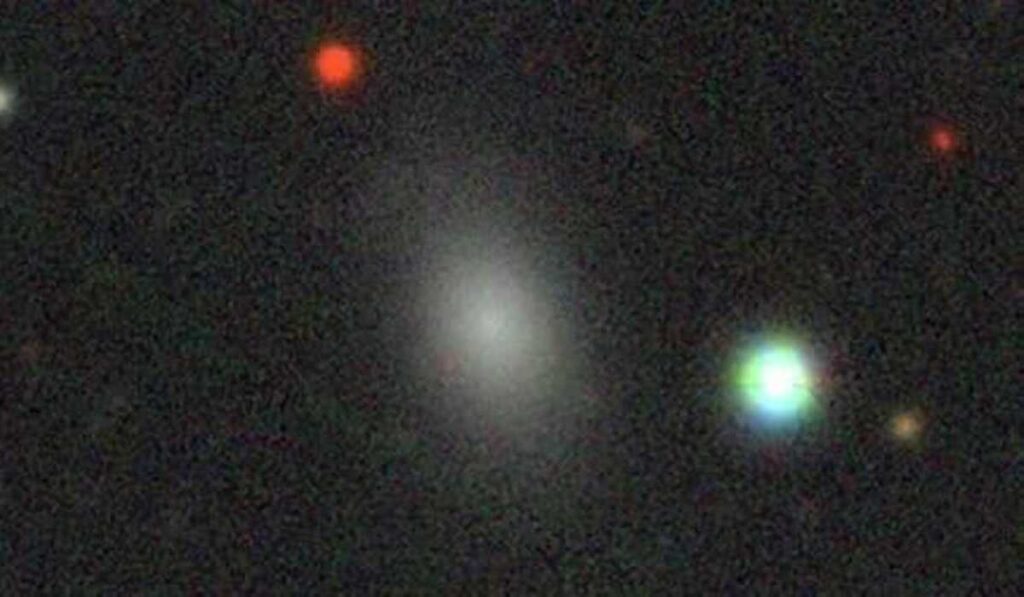
The Small Magellanic Cloud may not be an intact galaxy anymore. New research suggests the dwarf galaxy, which orbits the Milky Way, is likely being pulled into two parts by the gravity of the Large Magellanic Cloud.
The finding gives astronomers a sharper view of how active the Milky Way’s neighborhood may be. What looks like a faint companion from the Southern Hemisphere may actually be under severe gravitational stress.
Movement of thousands of young stars reveals the strain
A team from Nagoya University in Japan studied the motion of about 7,000 young massive stars inside the Small Magellanic Cloud. Young stars are especially useful for this kind of analysis because their movement can preserve clues about a galaxy’s early dynamics.
The results showed an unusual pattern. Stars on different sides of the Small Magellanic Cloud were moving in opposite directions, as if the galaxy were being pulled apart from its center.
Kengo Tachihara, one of the study’s lead authors, said that some stars are moving toward the Large Magellanic Cloud while others are moving away. That pattern strengthens the idea that the Small Magellanic Cloud is undergoing a breakup.
No clear sign of rotation
Another notable result was the lack of clear rotation in the population of massive stars inside the Small Magellanic Cloud. That is different from many other galaxies, including the Milky Way, which usually show a more orderly spin.
The absence of rotation has led researchers to suspect that the mass and shape of the Small Magellanic Cloud may not have been understood accurately. If the findings are confirmed, several older models about the interaction history of the Milky Way, the Small Magellanic Cloud, and the Large Magellanic Cloud may need to be revisited.
Satoya Nakano added that any revision would not only concern the galaxy’s structure, but also estimates of its mass and the long-term gravitational relationship among the three systems.
What this could mean for nearby galaxies
For centuries, the Small Magellanic Cloud has been known as one of the closest and easiest satellite galaxies to observe from Earth’s Southern Hemisphere. The new study suggests that the dwarf galaxy may now be in a major transition that is still not fully understood.
The possible “tearing” effect from the Large Magellanic Cloud offers astronomers a rare chance to watch how galaxy interactions can reshape a system of stars. On cosmic timescales, such changes can take a very long time, but the earliest signs are already visible in stars moving out of sync.
Astronomers will now continue monitoring whether the Small Magellanic Cloud will truly split into two smaller galaxies. Another possibility remains open as well: the galaxy may slowly be absorbed over time by the gravity of the Large Magellanic Cloud and the Milky Way.
Either outcome would change how scientists understand the fate of the Milky Way’s closest galactic neighbors. For now, the Small Magellanic Cloud remains a nearby object under close watch as researchers track whether its unusual motion becomes a full separation.