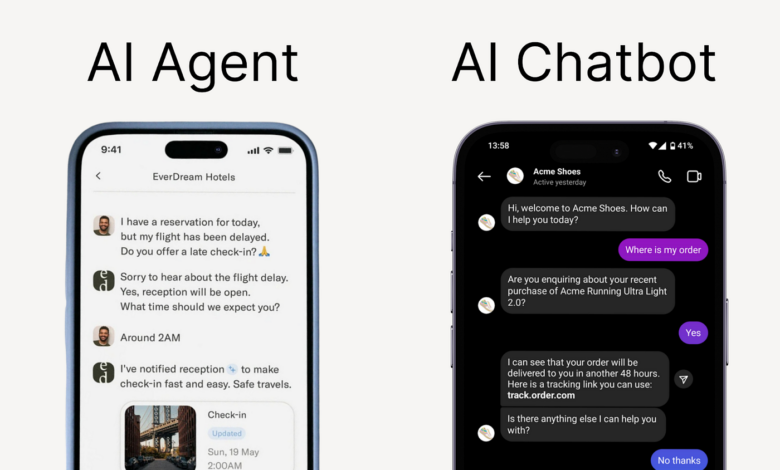
The gap between a chatbot and an AI agent is wider than many people assume. One is built to respond, while the other is designed to pursue a goal and carry out tasks with far less manual direction.
That difference matters for businesses and digital workers deciding which tool to use. In simple service scenarios, a chatbot is often enough, but more complex workflows call for a system that can act, not just reply.
Chatbots are built for quick, controlled interactions
A chatbot is a computer program that communicates through conversation. It usually follows predefined rules, scripted flows, or prepared answers stored in a database.
When a question comes in, the system searches for the most suitable response from the information it has. That makes chatbots useful for business hours, order status, product details, and basic guidance.
Some modern chatbots now use large language models, or LLMs, which makes the conversation feel more natural. Even so, without integration to other systems, a chatbot still mainly provides answers and does not actually take action.
AI agents are designed to work toward a goal
An AI agent is built to solve objectives more independently. Unlike a chatbot, it can reason through steps, choose tools, and carry out a chain of tasks without needing instruction at every stage.
A travel booking request shows the difference clearly. An AI agent can look up schedules, compare prices, weigh options based on preferences, and complete a booking if it has access to the required system.
The biggest difference is autonomy
Chatbots are best suited to simple questions and information that already exists in a system. AI agents are better for work that involves multiple steps, such as making reports, arranging meetings, finding data from several sources, or automating routine tasks.
Decision-making also separates the two. A chatbot follows the rules it has been given, while an AI agent can analyze a situation, choose the best next step, and adjust its actions to reach the intended outcome.
Context handling is another dividing line. Most chatbots only retain context within a single conversation session, while AI agents can understand context more deeply and, in some systems, remember user preferences over time.
Integrations give AI agents a much broader role
Chatbots typically pull information from a database or a specific system. AI agents can work across multiple tools at once, including calendars, email, project management apps, company databases, and cloud services.
That ability allows them to send emails, create customer service tickets, schedule meetings, and run specific workflows on their own. On the personalization side, they can also learn user habits and preferences so their suggestions and actions become more relevant.
Where chatbots still make sense
Despite the rise of AI agents, chatbots remain important for fast customer responses, product or service information, FAQ handling, and simple 24-hour conversation support.
They are also lighter and cheaper to deploy, which is why many companies still use them on websites, in customer service operations, and in online stores. For basic operational needs, a chatbot can still deliver solid efficiency without the complexity of a more advanced system.
Where AI agents have the advantage
AI agents are more useful when the work is complex and multi-layered. They can help manage work schedules, research, write and edit documents, generate code, automate administrative tasks, and connect several applications into one workflow.
The advantage is not only speed but independence. In practice, an AI agent is more than a conversational tool; it is a working system that can move toward a goal with less step-by-step supervision.