


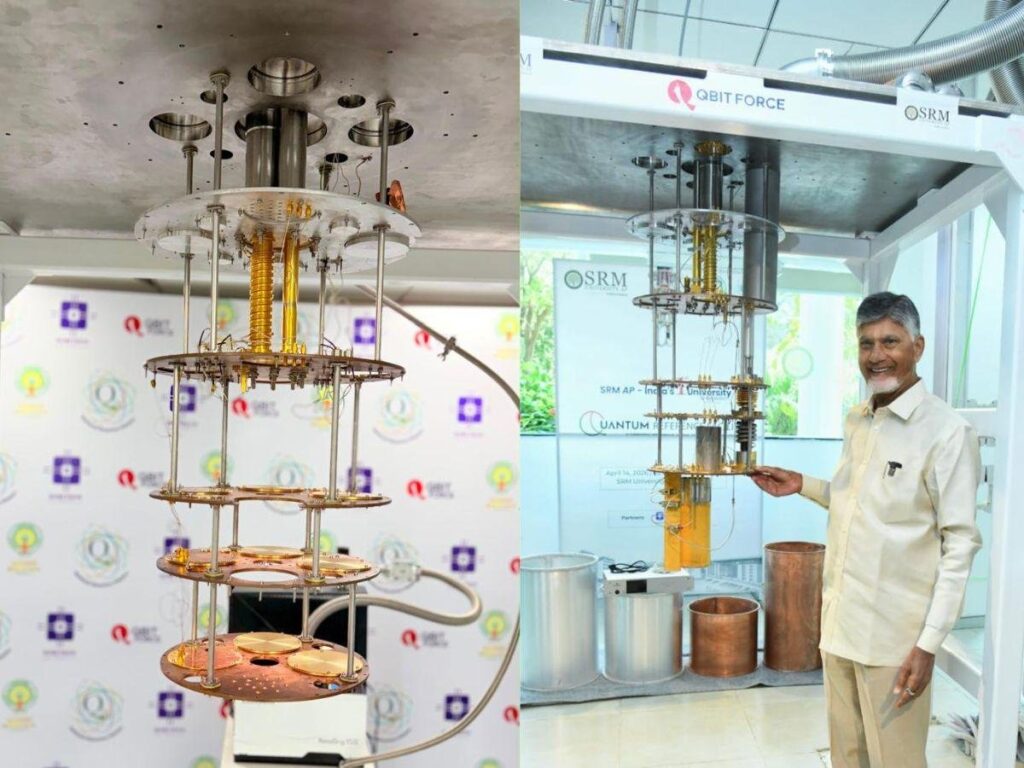
Amaravati has taken an important step in quantum hardware development after a locally built dilution refrigerator reached 4 Kelvin, or around minus 269 degrees Celsius. The milestone is being seen as a technical breakthrough that could help shape a domestic quantum computing facility in Andhra Pradesh.
The system was developed with more than 80 percent of its components sourced from within India, making it a notable example of local capability in a field that usually depends on highly specialized imported hardware. In practical terms, the achievement gives the region a working platform for testing the extreme cooling systems needed for advanced quantum research.
Why 4 Kelvin matters
Quantum computers do not process information the same way conventional machines do. Instead of standard bits that hold either 0 or 1, they use qubits that can explore multiple possibilities at once.
That design creates the promise of faster progress on complex scientific and computational problems. But it also creates a major engineering challenge, because qubits are fragile and require extremely precise conditions to remain stable.
To work properly, many quantum systems must be cooled close to absolute zero, around 15 millikelvin. A dilution refrigerator is the device designed to make that possible, often pushing temperatures to about 10 millikelvin, or roughly minus 273.14 degrees Celsius.
At that level, 4 Kelvin is not the final target. It is an early and essential stage that shows the system is moving in the right direction before it is pushed further into the millikelvin range required for superconducting quantum applications.
A platform for more than one machine
Even at 4 Kelvin, the refrigerator can already be used to test and characterize several kinds of components. Those include superconducting devices, quantum sensors, and cryogenic electronics.
That makes the facility valuable not only for one project, but for the broader quantum hardware ecosystem. It can serve as a testbed for the technologies that need to work together before a full superconducting quantum infrastructure can function reliably.
The development also shows that India’s quantum push is not limited to software research or theory. The Amaravati effort places a strong emphasis on hardware foundations, which are widely considered much harder to build.
Andhra Pradesh is betting on local capability
Andhra Pradesh has been advancing its quantum computing agenda for some time. In September last year, scientists, researchers, startups, and industry participants met with Chief Minister N. Chandrababu Naidu to present an assessment that nearly 85 percent of the components needed for quantum computing infrastructure could be developed in India.
That assessment helped support a broader localization strategy. The goal is not only to reduce dependence on imports, but also to create a domestic supply chain for an advanced technology sector.
After that, Amaravati Quantum Valley began working with Qbit Force and Qubitech to map India’s quantum hardware supply chain and identify local development opportunities, especially in cryogenic technology.
Cryogenics is one of the most critical areas because superconducting quantum architectures rely on extreme cooling. Without a stable and precise refrigerator, qubits cannot perform as required.
What the Medha Towers facility adds
The dilution refrigerator was tested at the Quantum Reference Facility in Medha Towers, Amaravati, which was established in April 2026 as India’s first such facility. The site is now becoming a central location for hardware testing, validation, and development inside the country.
Reaching 4 Kelvin gives that center a tangible technical result and strengthens Amaravati Quantum Valley’s ambition to become a leader in quantum computing. It also underscores how the next wave of technology competition will depend on mastery of extreme hardware rather than software alone.
The next stage will be to bring the system down further toward millikelvin temperatures. If that target is met, the facility in Amaravati will be better positioned to support more advanced superconducting quantum applications and expand India’s quantum hardware research base.