


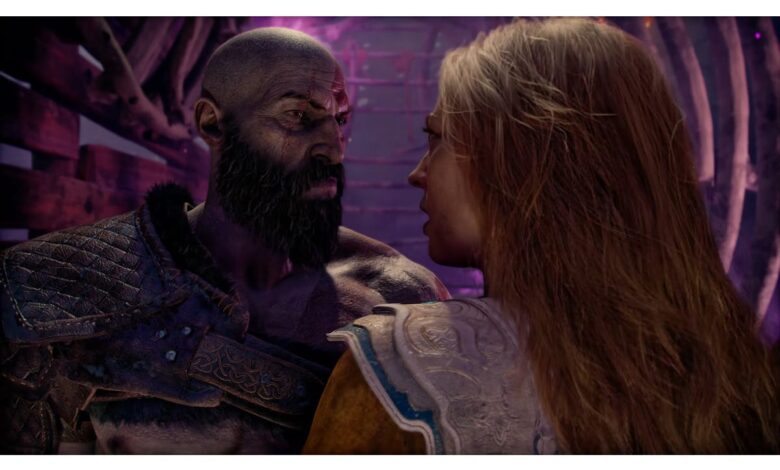
God of War is taking one of its boldest turns yet by moving away from Kratos and placing Laufey, also known as Faye, at the center of the story. The shift gives new weight to a character who has long shaped the series from the background.
That change matters because the new game is not simply continuing Kratos’ journey. It is instead exploring Laufey’s path after death, with a setting that opens the door to a much broader conflict than the series has shown before.
Everywhen becomes the new stage
The biggest setting change comes through Everywhen, a cosmic afterlife described as more than a underworld. According to PlayStation’s official blog and the trailer, it is a dimension where magic begins and ultimately returns.
That idea immediately expands the scope of the series. Everywhen appears to bring together gods and creatures from several mythologies, turning the world into a place where old enemies and unfamiliar powers can collide.
A familiar family story gains new meaning
Laufey has always had a deeper place in God of War than many players first realized. In Midgard, she lived a simple life, but her true identity was that of a Jötunn from Jötunheim and a legendary defender of ordinary people.
Her role first became central in God of War (2018), which opened with Kratos and Atreus fulfilling her final wish to scatter her ashes in Jötunheim. In God of War Ragnarök, she later appeared directly through Kratos’ dreams, with Deborah Ann Woll providing the voice and performance.
Two unusual companions join the journey
Laufey does not travel through Everywhen alone. The first trailer introduced Phranque and Rue, two companions with designs that immediately stood out.
Phranque is a sentient gelatin cube described as intelligent and humorous, with Jack Quaid voicing the character. Rue is a ribbon-like magical entity tied to Laufey’s sword and voiced by Perlina Lau.
Their presence has already sparked fan theories, including speculation that Phranque may grow into a major mythological figure as the story progresses.
Combat looks faster and more fluid
Gameplay footage suggests that Laufey fights very differently from Kratos. Her style is more agile and artistic, mixing sword strikes on the ground and in the air with mysterious magic in her left hand.
She can launch enemies upward, dodge quickly, and use Rue to extend her range or pull opponents closer. Phranque also adds pressure by disrupting enemies, including boss-level threats.
The magic appears to react to Everywhen itself, hinting that Laufey’s abilities may continue to evolve as the game advances.
Mythologies begin to collide
The trailer also makes clear that Santa Monica Studio is broadening the series’ mythology. Rather than staying within a single pantheon, the game appears ready to place figures from multiple traditions into the same narrative space.
Begtse, the war deity from Tibetan and Mongolian mythology, appears as an early boss with a threatening presence. Sekhmet, the Egyptian goddess of war and destruction, also shows up with solar power that looks devastating.
Their inclusion suggests a conflict on a much larger scale than previous entries, with Everywhen serving as the place where those mythological lines intersect.
Old gods may not be gone for good
One of the most intriguing possibilities is the return of gods Kratos had already defeated. Zeus, Hades, and Ares are all mentioned as potential appearances, which could help answer one of the franchise’s oldest mysteries: where gods go after death.
At the moment, Sony and Santa Monica Studio have not announced an official release date for the game. Bloomberg journalist Jason Schreier has said the project has been in development for a long time and may already be relatively close to completion.
Because of its connection to Ragnarök, which launched in 2022, some players expect the next game to arrive around 2027. That remains speculation, but the long development window has kept expectations high.