


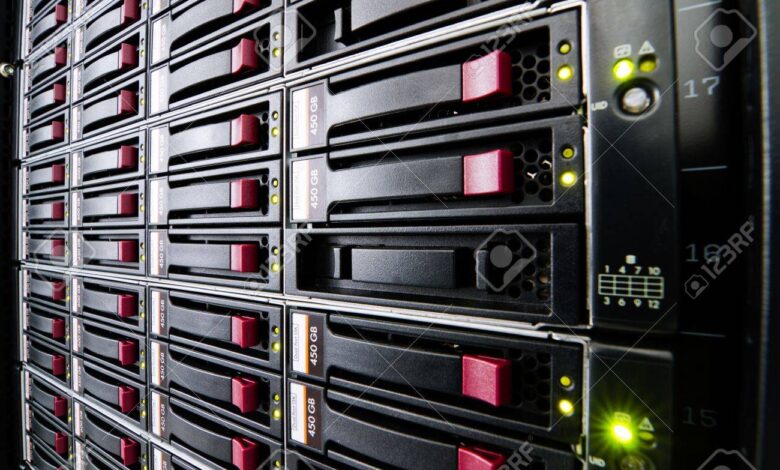
Google helped redefine storage by treating hard drive failures as a design assumption, not a disaster. That shift changed how companies think about reliability, cost, and scale in the data center.
For home PC users, a failed hard drive is usually a crisis. For Google, especially in its early years, failure was simply one more event that had to be expected when thousands of disks were running at once.
Reliability moved from the drive to the system
Instead of depending on a small number of expensive storage systems that had to work perfectly, Google built clusters from commodity machines and low-cost drives. Data was spread across many devices so that no single disk, server, or rack held the only copy of anything important.
When one drive failed, the system could still retrieve data from elsewhere and rebuild the missing pieces. In that model, reliability was no longer measured by the lifespan of one drive, but by how well thousands of drives could fail without taking data down with them.
That approach also changed the role of hardware. Google placed more responsibility on software, using replication, monitoring, and automatic recovery to keep storage resilient.
Cheap hardware became a strategy, not a compromise
Much of Google’s early storage depended on commodity hardware that would have been considered cheap, and even consumer-grade, by traditional storage standards. The important point was not that the drives were better than enterprise models, but that scale made a different design possible.
Google treated failure as normal rather than rare. Even when a drive appeared to be healthy, it could still fail, which meant the system had to treat disks as replaceable parts rather than objects to trust blindly.
That idea had a wide impact on the industry. Google showed that at enough scale, the smartest system is the one that expects ordinary drives to fail and keeps working anyway.
Hard drives were eventually designed for the data center
Google later pushed the idea further by arguing that hard drives should be built specifically for the data center. In a 2016 research paper, Google researchers noted that disks were increasingly being used in large fleets rather than as single drives inside one machine.
This shifted the definition of a “good” drive. Performance was no longer judged only by one disk, but by how thousands of drives behaved together, including power use, capacity, predictable performance, recovery behavior, security, and fleet management efficiency.
At that scale, the individual HDD stopped being the main product. The storage system itself became the product.
Cloud computing pushed HDDs further into the background
The rise of cloud storage made that transition even clearer. The hard drives once visible inside personal computers became hidden infrastructure behind photo backups, synced folders, archived video, business databases, and massive training datasets.
SSD technology took over boot drives, gaming PCs, and systems that needed speed. HDDs remained relevant where the main goal was storing very large amounts of data at lower cost.
Cloud computing did not eliminate hard drives. Instead, it pushed them deeper into the role Google helped define: inexpensive, dense, and easily replaced storage that is most valuable when it operates as part of a much larger system.
The lesson goes beyond buying the cheapest drive
The real lesson is not simply to choose the lowest-priced drive. Google could use inexpensive hardware because each drive was only one part of a much larger system, and that is the part worth copying.
Relying on a single cheap HDD to keep files safe is not a strong strategy. Storing data in multiple places and preparing for replacement when a drive fails is much closer to the logic of modern storage, which grew out of Google’s bet that hard drives would break.