


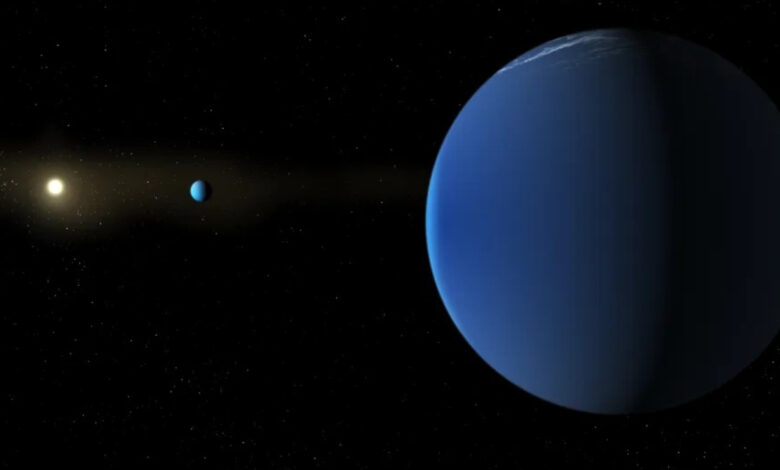
NASA’s TESS mission has identified two unusual exoplanets that stand out for a rare trait among giant worlds: they are enormous in size, but remarkably light for their volume. The pair, TOI-791 b and TOI-791 c, belongs to the “super-puff” class, a category used for planets with extremely low density.
That combination has made the system one of the most unusual planetary discoveries yet. Both planets orbit a Sun-like star named TOI-791, located about 1,113 light-years from Earth, and both appear far less massive than their sizes would suggest.
| Planet | Size | Mass | Orbital Period |
|---|---|---|---|
| TOI-791 b | Nearly Jupiter-sized | About 3.0% of Jupiter’s mass | 139 days |
| TOI-791 c | Larger than Jupiter | About 5.9% of Jupiter’s mass | 232 days |
A giant size with very little mass
TOI-791 b is almost the same size as Jupiter, but its mass is only about 3.0 percent of Jupiter’s. TOI-791 c appears even larger than Jupiter, yet its mass is just 5.9 percent of that gas giant’s mass.
That mismatch between bulk and weight places both objects among the puffiest planets ever recorded. In the study, they are described as the most “puffed up” planets found so far.
How TESS detected the pair
TESS found both planets using the transit method, which looks for a small, repeated dip in starlight when a planet crosses in front of its host star. Those regular drops in brightness gave astronomers a strong sign that two planets were orbiting TOI-791.
Their long orbital periods made the detection especially notable. Such planets are harder to identify through transits because they require extended monitoring before the pattern becomes clear.
Seven years of data made the discovery possible
TESS collected data on the TOI-791 system over 1,122 days across seven years, giving researchers a long enough baseline to catch the transit signatures. That extended view helped reveal changes in the star’s brightness with enough precision to confirm both worlds.
The long observation window was crucial because TOI-791 b and TOI-791 c do not circle their star quickly. Their 139-day and 232-day orbits are unusually long for planets identified this way.
Gravity between the planets gave away their masses
Follow-up analysis showed that the two planets do not move independently in a perfectly steady way. As they orbit their star, they tug on one another through gravity, which causes small shifts in the timing of their transits.
Those timing changes allowed astronomers to estimate their masses more accurately. The results confirmed that both planets are exceptionally light for giant worlds.
Why TOI-791 matters for exoplanet research
Having two super-puff planets in the same system makes TOI-791 a valuable target for further study. Worlds like these can help scientists understand how unusual planets form, evolve, and maintain such low density.
Future observations may help reveal the chemical makeup of their atmospheres, the role of rotation in shaping the planets, and the migration processes that carried them to their current orbits. The study was led by the University of Oxford and published in Monthly Notices of the Royal Astronomical Society.