


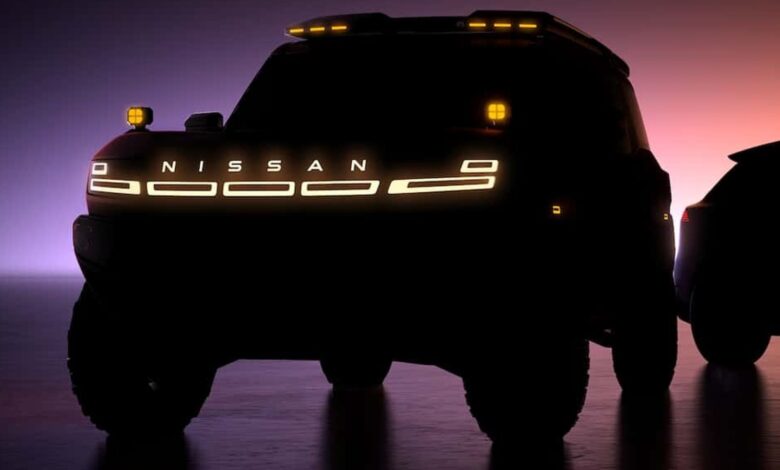
Nissan’s latest teaser has done more than hint at a new model. It has signaled a broader shift in the brand’s design language, with a silhouette that looks markedly more futuristic than the company’s recent lineup.
The most striking part of the preview is not a single detail, but the overall impression. Tight LED lighting, sharp body lines, and a streamlined stance suggest that Nissan is preparing something meant to stand out in a crowded electrified market.
A stronger visual identity
The front end appears to use thin, connected LED lighting that immediately gives the vehicle a modern signature. That kind of treatment is increasingly common among global automakers that want their models to be recognized at a glance.
The side profile adds to that impression with clear aerodynamic shaping. Such lines are often associated with efficiency, especially when a car is expected to play a role in electrification-focused product planning.
Analysts have therefore interpreted the teaser as pointing toward a next-generation electric vehicle. That reading fits Nissan’s history, especially after the company built a strong EV reputation with the Leaf in multiple global markets.
More than a single model?
There is also speculation that the teaser may be tied to a new, more flexible platform. If that proves true, it could become an important foundation for several Nissan products in the years ahead.
The teaser’s more aggressive styling has also raised the possibility of a wider design reset. In that case, the preview would not only introduce one new vehicle, but also hint at the visual direction of future Nissan models across different segments.
| Teaser Clue | What It Suggests | Why It Matters |
|---|---|---|
| Thin LED lighting | Modern front-end identity | Helps build a recognizable brand signature |
| Aerodynamic side profile | Efficiency-focused shaping | Useful for an EV-oriented model |
| Futuristic silhouette | A possible design reset | Could influence more than one future product |
Technology expectations are rising
Although Nissan has not confirmed the technical package, the teaser has already prompted expectations around advanced driver assistance, cloud-based connectivity, and wider smartphone integration. Those features align with what many buyers now expect from a modern electric vehicle.
Over-the-air software updates are also considered a likely part of the strategy. That approach allows a car to gain improvements after purchase without requiring a workshop visit every time a new function is introduced.
Battery efficiency is another area drawing attention. If the teaser indeed points to an EV, stronger range potential and faster charging would be natural priorities in a market where competition is becoming more intense.
Safety technology is expected to remain central as well, with more complete sensor coverage likely to be part of the package. Large high-resolution infotainment screens are also part of the picture, reflecting how cabin technology has become a major deciding factor for buyers.
Nissan has not revealed the model’s identity, and that uncertainty is part of what has made the teaser so effective. By showing enough to suggest a major change without giving away the product, the company has created the kind of anticipation that can carry a model well before launch.
For now, the clearest message is that Nissan appears ready to push further into the next phase of electrified mobility. The teaser’s design cues, combined with the technology expectations around it, point to a vehicle intended to matter beyond simple styling updates.