


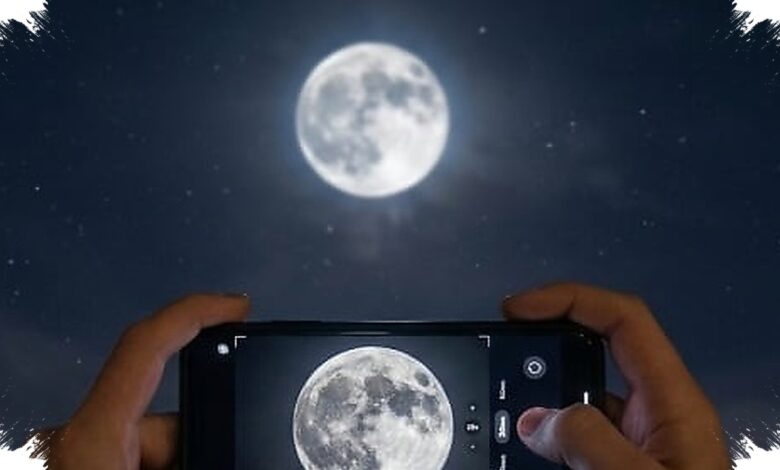
Moon photography is no longer limited to dedicated cameras. A handful of high-end phones now combine powerful telephoto systems, large sensors, stabilization, and AI processing to help distant subjects appear clearer and more natural.
That matters because the biggest difference between a clean moon shot and a soft, blocky image is not just magnification. Optical telephoto hardware preserves detail far better than ordinary digital zoom, especially when the goal is to keep crater texture visible.
The Samsung Galaxy S26 Ultra remains one of the strongest choices for long-distance photography. It uses a 50 MP periscope telephoto lens with an f/2.9 aperture, 5x optical zoom, and 10x optical quality zoom.
Its standout feature is 100x Space Zoom, now supported by a newer AI system. When pointed at the moon, the AI can identify the subject and enhance crater texture so the surface looks more dramatic and detailed.
| Phone | Telephoto Highlight | Moon Shot Strength |
|---|---|---|
| Samsung Galaxy S26 Ultra | 50 MP periscope telephoto, 5x optical zoom, 10x optical quality zoom | 100x Space Zoom with AI-enhanced texture |
| Xiaomi 17 Ultra | 200 MP telephoto, continuous optical zoom from 75mm to 100mm | Sharp output with good color accuracy |
| Oppo Find X9 Ultra | Dual 200 MP setup, 50 MP ultra telephoto with 10x optical zoom | Strong reach with minimal distortion |
| Vivo X300 Pro | 200 MP ZEISS APO Telephoto Camera, periscope, OIS | Precise color correction and steadier low-light shots |
2. Xiaomi 17 Ultra
The Xiaomi 17 Ultra takes a different approach with continuous optical zoom, a feature more closely associated with professional camera systems. Its 200 MP telephoto camera offers a physical optical range from 75mm to 100mm, or roughly 3.2x to 4.3x magnification.
The large sensor gives more room for cropping without losing too much detail. That makes the phone appealing for users who want fine texture and accurate color in moon photos.
3. Oppo Find X9 Ultra
The Oppo Find X9 Ultra relies on two high-resolution sensors to maintain image quality at different focal distances. Its setup includes a Dual 200 MP camera for the main lens and 3x telephoto, plus a 50 MP ultra telephoto lens for 10x optical zoom.
The phone can also reach 120x digital zoom. With 10x optical zoom and a 200 MP sensor foundation, it is designed to handle very distant subjects with minimal distortion.
4. Vivo X300 Pro
The Vivo X300 Pro leans heavily on its partnership with ZEISS. It uses a 200 MP ZEISS APO Telephoto Camera with apochromatic certification for more precise color correction.
That APO label helps reduce chromatic aberration, while the periscope design and Optical Image Stabilization support steadier shooting. The combination is especially useful in low light and when capturing the moon’s finer details.
These four phones take different paths to the same goal. Samsung leans on AI, Xiaomi emphasizes continuous optical zoom, Oppo offers a flexible high-resolution setup, and Vivo focuses on ZEISS optics and stabilization.
For users who want sharper moon photos, the best choice depends on whether the priority is crater texture, zoom flexibility, or consistent color in dim conditions. With modern telephoto hardware, moon shots can look far more convincing than what ordinary digital zoom usually delivers.