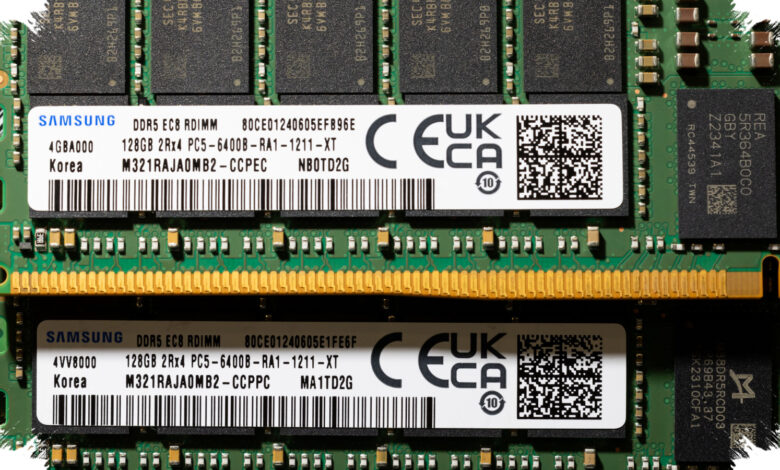
RAM prices are unlikely to fall back to comfortable levels anytime soon, and the main force behind that pressure is not consumer demand. The sharper driver is the global memory-chip shortage being fueled by the rapid expansion of AI infrastructure.
That shift is changing who gets priority in the supply chain. Makers of AI servers and model-processing systems are absorbing more production capacity, leaving less room for the memory chips used in consumer devices, DIY PCs, and other everyday electronics.
AI buyers are outbidding the consumer market
The memory market is dominated by only a few major companies, led by Samsung Electronics, SK Hynix, and Micron Technology in DRAM production. Building new fabrication plants takes years, which makes supply slow to respond when demand surges.
At the moment, those companies are redirecting more capacity toward AI demand, where buyers are willing to pay the highest prices to secure supply. Jim Secreto, a consultant who previously worked at the U.S. Department of Commerce under the Biden administration, said AI companies have the “deepest pockets” and are effectively pushing costs onto regular buyers.
Apple has reportedly already felt the impact. The shortage of memory chips is described as one of the underlying reasons behind the company’s decision to raise prices on its latest products.
New supply will take time to arrive
There is no quick fix available for the U.S. government, and domestic semiconductor expansion is moving slowly. The problem is structural: demand is changing fast, while physical manufacturing cannot be scaled at the same pace.
Micron is moving ahead with major memory-chip projects in Boise, Idaho, and Clay, New York. Even so, the Idaho facility is not expected to begin operating until mid-2027, while the New York plant is projected to start production in 2030.
| Company | Expansion Plan | Expected Timing |
|---|---|---|
| Micron | Boise, Idaho memory-chip plant | Mid-2027 |
| Micron | Clay, New York memory-chip plant | 2030 |
Kathryn Mitchell, a technology policy adviser at the law firm DLA Piper who works with the U.S. Department of Commerce, described the situation as a fast-moving technology shift held back by a slow physical system. In practical terms, the market needs more chips now, but the extra supply is still years away.
Why chipmakers remain cautious
Producers also have another reason to hesitate: memory has long been a boom-and-bust business. Companies are wary of adding too much capacity too quickly because oversupply can hit prices and profits hard.
That caution is rooted in recent history. In 2023, SK Hynix reported losses of billions of dollars and cut production during a weak global market, while Micron laid off 15% of its workforce in the same year.
The AI surge changed the picture quickly. Demand for memory chips used in data centers and AI systems has climbed sharply, and AI data centers also consume large amounts of traditional memory chips.
China is not an easy escape route
In theory, China could ease the shortage faster than new Western plants, at least temporarily. CXMT and YMTC are expanding aggressively and trying to grow their global reach.
The Wall Street Journal reported that YMTC is building three new factories in China and aims to double production capacity by the end of 2027. CXMT is also expanding its plants and seeking $4 billion through an IPO on the Shanghai Stock Exchange.
| Company | Reported Move | Goal |
|---|---|---|
| YMTC | Three new plants in China | Double capacity by end of 2027 |
| CXMT | Plant expansion and IPO plan | Raise $4 billion |
CXMT’s revenue in the first quarter jumped more than 700% from a year earlier, although the company still says its technology trails Samsung, SK Hynix, and Micron. Even so, U.S. national security rules remain a major barrier, making technology cooperation with Chinese chipmakers nearly impossible for American companies.
Washington wants to protect core chip technology while preserving the market position of Micron and suppliers from South Korea and Japan. Kevin Wolf, an attorney at Akin Gump, framed the dilemma directly by asking which risk is greater: a shortage of components or support for China’s advanced memory production.
The same tension has appeared before. In 2022, Apple reached an agreement with YMTC to supply flash memory, but the plan was dropped after strong pressure from U.S. lawmakers.
For consumers, the result is straightforward: as AI keeps pulling memory supply toward data centers and high-end infrastructure, RAM and related components may remain expensive for an extended period.