HamsterOS is drawing attention for a reason that sounds almost impossible in modern computing: it delivers a full 32-bit desktop operating system inside a single 1.44MB floppy disk. The project is not a stripped-down boot demo, but a complete graphical system aimed at vintage PCs.
What makes it stand out is not only the tiny storage footprint, but also the target hardware. HamsterOS is built for i386 and 486-era machines and is designed to bring back the look and feel of a real desktop, complete with windows, applications, and even games.
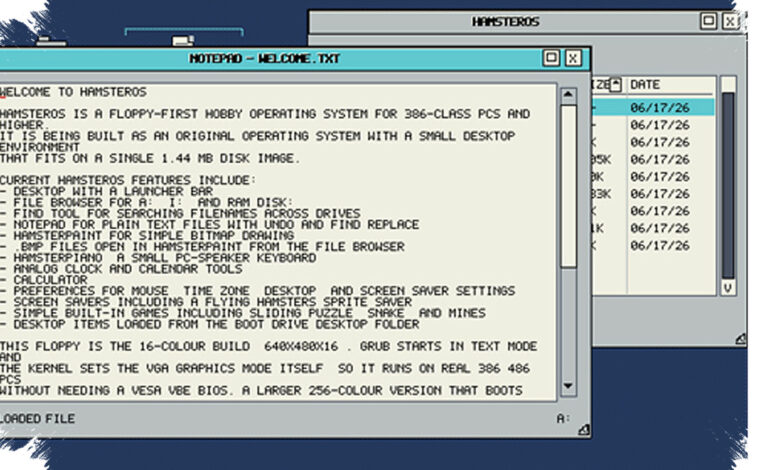
A full GUI OS in 1.44MB
The project has attracted interest because it pushes software compression and system design to an extreme. Its developer describes it as a “complete 32-bit desktop OS on a single 1.44 MB floppy,” and that description is not marketing fluff.
Unlike a text-only utility disk, HamsterOS is meant to provide an actual desktop environment. It gives users a graphical shell on vintage hardware rather than a bare command-line experience.
According to Hackaday, HamsterOS is a mini operating system built for old machines and written in Assembly. It is neither a cut-down Windows build nor a lightweight Linux distribution, but a standalone system with its own identity and technical approach.
Boot path and technical base
The current master image boots through a trimmed FreeDOS wrapper before loading the 32-bit HamsterOS kernel with HAMLOAD.EXE. That setup lets FreeDOS handle the initial launch sequence before HamsterOS takes over.
The system has already reached the stage where it can run a real windowed desktop on 386 and 486-class hardware. In other words, the project is focused on usability as much as on proving what can be squeezed into a floppy disk.
HamsterOS is also not limited to floppy-only use. From the floppy boot menu, it can install or upgrade itself onto a bootable ATA hard drive, giving older systems a more permanent way to run it.
DOS is still part of the picture
One of the more unusual details is how the installation treats DOS. When installed to a hard drive, HamsterOS keeps the C: drive as the original DOS disk and can then start itself automatically from there.
That approach makes the project especially appealing to retro computing fans who want to preserve the original DOS environment. Rather than replacing everything, HamsterOS layers a desktop experience on top of an older PC setup.
It also gives the project a practical edge beyond novelty. For collectors and hobbyists, keeping DOS intact can matter just as much as the novelty of a tiny operating system.
More than a proof of concept
Ultra-small operating systems are not new, but HamsterOS stands out because it is presented as a complete GUI desktop with a distinct visual identity. The project is no longer just about proving that something can boot from a floppy.
Development progress suggests it has moved well beyond the basic stage. The system now includes a desktop shell, applications, and even games, which makes it feel closer to a usable retro environment than a technical demo.
The developer is still polishing the final details before public release. That means the current focus is on refining the user experience rather than building the core from scratch.
Release timing and retro appeal
HamsterOS is scheduled to launch in November 2026. When it arrives, anyone with a floppy disk and working legacy hardware will be able to see a full graphical desktop running from just 1.44MB.
The project’s visual style also appears to match the hardware era it targets. With Assembly code, vintage PC support, and a windowed desktop packed into a floppy, HamsterOS has become one of the most unusual retro OS projects in circulation.
At a time when modern operating systems keep growing larger and more complex, HamsterOS points in the opposite direction. It shows that on 386 and 486 machines, even an old floppy disk can still hold a complete 32-bit desktop.