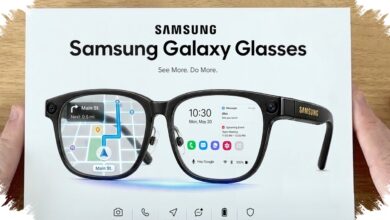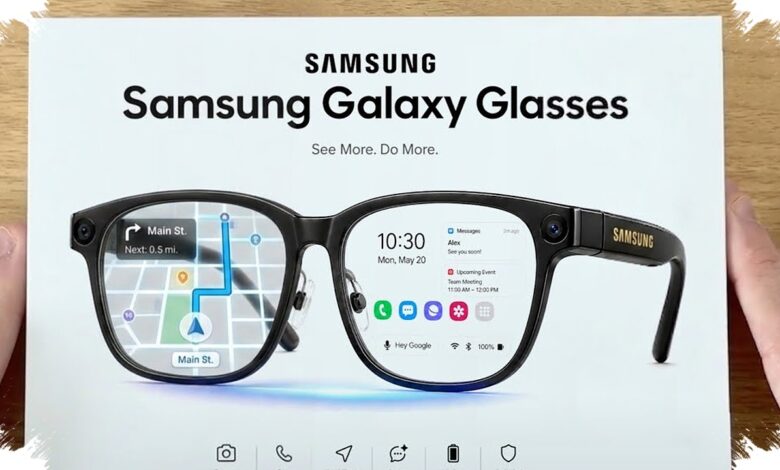
Samsung appears to be closing in on the launch of its long-rumored AI-powered smart glasses. A 27-second leaked video shared by SamMobile offers the clearest look yet at the device believed to be called Galaxy Glasses.
The most notable detail is not a futuristic redesign, but the opposite. Samsung seems to be aiming for a familiar sunglasses-style form factor, a choice that puts the device in direct competition with Meta’s Ray-Ban smart glasses.
A design built to look ordinary
The leaked clip shows Galaxy Glasses with square-shaped lenses and thick temples. Those temples are widely believed to house the main electronics while keeping the overall profile understated.
Several physical elements are visible in the video. These include a touch-sensitive area on the right temple, a power button, an outward-facing LED indicator, and a camera placed on the other side of the frame.
The design details also align with earlier CAD render leaks, which described a clean look with a small camera opening and very limited branding. Samsung appears to be avoiding anything that would make the product look experimental or difficult to wear in everyday settings.
Touch controls, camera actions, and phone integration
One animation in the leaked video appears to show touch controls on the right temple. Users may be able to adjust volume, control media playback, and move through the interface with one- or two-finger gestures.
That approach closely resembles the interaction model used by Meta on its Ray-Ban smart glasses. The similarity suggests Samsung is aiming squarely at the same category rather than creating an entirely new wearable experience.
The camera system is also a major part of the concept. The shutter button on the top of the right temple is said to take a photo with a single press, while a longer press begins video recording.
When photos or videos are captured, an external LED is expected to light up as a recording indicator. At the same time, an inward-facing LED is said to notify the wearer.
| Feature | Leak Detail | Expected Role |
|---|---|---|
| Touch area | Right temple | Media and interface control |
| Shutter button | Top of right temple | Photo and video capture |
| LED indicators | Inside and outside the frame | Recording and wearer notification |
| Camera | Frame-mounted | Capture photos and video |
Another animation reportedly shows captured photos and videos appearing immediately on a connected Galaxy phone through Samsung’s Now Bar interface. That detail reinforces the idea that the glasses are meant to function as an extension of the wider Galaxy ecosystem.
Positioned as an AI-first wearable
Beyond hardware, Galaxy Glasses is said to be built as an AI-focused wearable. The device is reportedly based on Android XR and powered by Google’s Gemini AI.
Earlier leaks suggested the glasses would support hands-free tasks such as taking photos, recording videos, answering questions, live translation, turn-by-turn navigation, music playback, and voice assistance.
Most of the heavy processing is likely to be handled by a connected phone rather than the glasses themselves. That approach could help keep the device light enough for everyday wear.
Samsung’s strategy suggests the company is not trying to sell only a camera accessory for the face. Instead, it appears to be building a new entry point into a broader AI ecosystem.
Specs that have already surfaced
Previous reports have pointed to a Qualcomm Snapdragon AR1 chipset inside Galaxy Glasses. Connectivity is said to include Wi‑Fi and Bluetooth 5.3.
The camera is rumored to use a 12-megapixel sensor believed to be the Sony IMX681. The device is also said to include built-in microphones, directional speakers, and touch controls.
Samsung is also said to be preparing photochromic lenses that can adapt automatically to changing light conditions. If accurate, that would make the glasses feel more like a daily accessory than a pure technology showcase.
The weight is rumored to be around 50 grams. Galaxy Glasses is also said to include a 155mAh battery and recharge through a dedicated carrying case.
Broad Android support, deeper Galaxy advantage
Leaked details from Samsung’s companion app previously suggested the glasses will work with most Android phones. Even so, Galaxy devices are expected to receive deeper integration than other Android handsets.
There are also indications of compatibility with One UI XR, Galaxy Watch, and Galaxy Ring. Tighter integration with Google services such as Maps and Gemini points to a connected AI ecosystem rather than a standalone device.
Samsung has not officially announced Galaxy Glasses yet. However, current chatter suggests the device could be introduced at the next Galaxy Unpacked event in London on July 22.
Because the details so far come from leaks, the final design, features, and specifications could still change. Even so, the latest video strongly indicates that Samsung is serious about entering the smart glasses market with a product that follows a formula already proven by Meta Ray-Ban.