


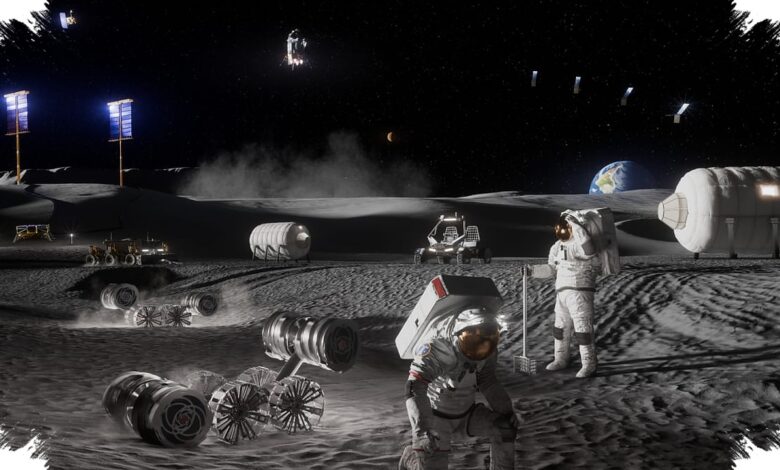
NASA has awarded three private space companies four new lunar missions through the end of 2028, signaling a more concrete push toward a sustained human presence on the Moon.
The contracts go to Astrobotic, Firefly Aerospace, and Intuitive Machines, each tasked with delivering NASA science payloads designed to support both research and the early infrastructure needed for future lunar operations.
A broader plan behind the contracts
The missions are tied directly to NASA’s Moon Base Program, a long-term effort meant to expand scientific and commercial activity on the lunar surface. The program is intended to help lay the groundwork for a more permanent human presence beyond Earth.
For NASA, these flights are not limited to short-term science returns. They are also being used to build the operational foundation that future routine activity on the Moon will require.
| Company | Number of Missions | Contract Value |
|---|---|---|
| Astrobotic | 2 | $297.9 million |
| Firefly Aerospace | 1 | $144.2 million |
| Intuitive Machines | 1 | $148.3 million |
How NASA divided the work
Astrobotic received the largest share of the new package, with a contract worth $297.9 million to carry out two lunar deliveries. Firefly Aerospace was assigned one mission under a $144.2 million contract.
Intuitive Machines also secured one mission, with NASA setting its contract value at $148.3 million. The division gives NASA four lunar deliveries across three commercial partners already active in lunar lander development.
All four missions will use updated versions of the lunar lander design that has been used before, but with more advanced capabilities. NASA expects the upgrade to support a higher mission cadence in the years ahead.
Three instruments, repeated across every flight
Each mission will carry the same three NASA instruments to the Moon. That repeated approach is intended to widen the scientific dataset while keeping the measurements consistent across multiple landing sites.
The payloads are the Stereo Camera for Lunar Plume Surface Studies, the Laser Retroreflector Array, and the Linear Energy Transfer Spectrometer. They will be delivered on four separate flights.
The Stereo Camera for Lunar Plume Surface Studies will examine the surface area affected by the exhaust plume during landing. NASA considers that information essential for understanding the conditions a spacecraft encounters as it descends to the Moon.
The Laser Retroreflector Array will serve as both a location marker and part of a broader measurement network. The Linear Energy Transfer Spectrometer will help study the lunar environment.
Why the repeated payload matters
Joel Kearns, deputy associate administrator for exploration in NASA’s Science Mission Directorate, said the use of identical instruments on several landers will improve understanding of landing hazards. He added that the approach will also help build a global network of environmental data and lunar location markers.
That strategy reflects NASA’s preparation for a future in which lunar operations must be safer, more frequent, and more coordinated. Landing risk, environmental conditions, and precise positioning all matter as the agency moves toward longer-term activity on the surface.
If the schedule holds through the end of 2028, NASA will end up with a connected set of environmental observations and location references from multiple landers. Those results are expected to support the next phase of lunar exploration and the infrastructure needed for human operations on the Moon.