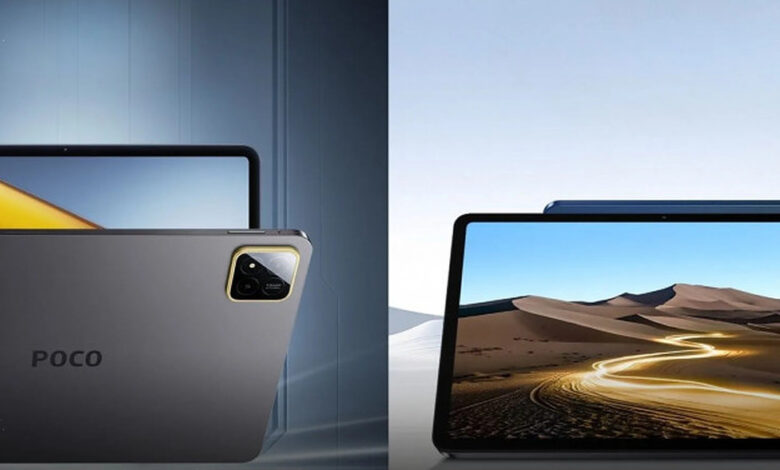
Poco’s two large tablets are aimed at different kinds of users, even though both are built with quad speakers and a strong media focus. For gaming, the more sensible choice depends on whether performance or endurance matters more.
Poco Pad X1 is the sharper option for players who want fast response, higher refresh rates, and stronger hardware for multitasking. Poco Pad M1, by contrast, leans toward a bigger display and a larger battery for longer, more relaxed use.
Poco Pad X1 leans toward speed and competitive play
The Poco Pad X1 is powered by Snapdragon 7+ Gen 3, paired with 8 GB of RAM and 512 GB of UFS 4.0 storage. That combination gives it an advantage in app loading, switching between games, and handling heavy multitasking.
Its 11.2-inch display brings 3.2K resolution and a 144 Hz refresh rate, which makes motion look smoother in fast-paced games. Dolby Vision support also adds more visual impact when the tablet is used for entertainment.
The battery capacity stands at 8,850 mAh, with 45W fast charging. For users who play often and want shorter charging time, that setup is easier to live with.
Poco Pad M1 focuses on screen size and longer battery life
Poco Pad M1 takes a different route with a 12.1-inch 2.5K display and a 120 Hz refresh rate. The larger panel gives more room for watching videos, reading documents, and using on-screen controls in games.
It runs on Snapdragon 7s Gen 4 and still handles popular games, but it is better suited to casual play or competitive titles at medium graphics settings. That makes it a better fit for users who place comfort and entertainment above raw performance.
The battery is the bigger talking point here, at 12,000 mAh, supported by 33W fast charging and 27W reverse charging. Poco Pad M1 also keeps a 3.5 mm audio jack, which remains useful for wired headset users.
Camera, audio, and price differences keep the choice clear
On the camera side, Poco Pad X1 carries a 13 MP rear camera and an 8 MP front camera. Poco Pad M1 uses 8 MP cameras on both the front and rear.
Both tablets use quad speakers with Dolby Atmos, so they still deliver an immersive audio experience for films and games. Medcom.id noted that both remain adequate for video calls, online classes, and basic documentation.
| Aspect | Poco Pad X1 | Poco Pad M1 |
|---|---|---|
| Chipset | Snapdragon 7+ Gen 3 | Snapdragon 7s Gen 4 |
| RAM / Storage | 8 GB / 512 GB UFS 4.0 | 8 GB / 256 GB |
| Display | 11.2-inch, 3.2K, 144 Hz | 12.1-inch, 2.5K, 120 Hz |
| Battery | 8,850 mAh, 45W | 12,000 mAh, 33W, 27W reverse charging |
Price is another reason the two models land in different camps. Poco Pad X1 with 8 GB/512 GB is priced at around Rp5.6 million to Rp6 million, while Poco Pad M1 with 8 GB/256 GB sits at around Rp4.3 million to Rp4.7 million.
That gap of roughly Rp1.3 million to Rp1.6 million makes the decision straightforward. Poco Pad X1 is the more logical pick for gaming performance and productivity, while Poco Pad M1 makes more sense for buyers who want a larger screen, longer battery life, and a lower price.