


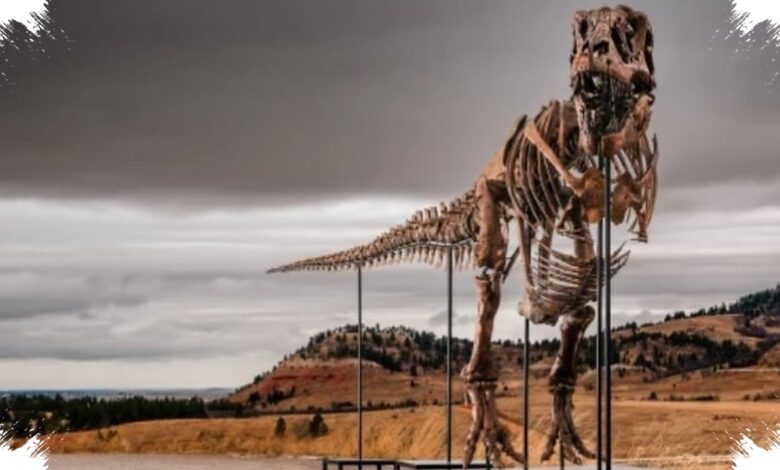
One of the most closely watched fossils at Sotheby’s New York is not just large and rare. It is also a Tyrannosaurus Rex named Gus, a nearly complete prehistoric skeleton that may rank among the most expensive dinosaur remains ever offered to the public.
The specimen measures 11.6 meters in length and stands 3.8 meters high. Sotheby’s says Gus lived in North America during the Maastrichtian period, roughly 72 million to 66 million years ago.
Why Gus Carries So Much Attention
The fossil has drawn interest because of its size, its preservation, and the difficulty of recovering a creature that old from the ground. Cassandra Hatton, Sotheby’s Global Head of Science and Natural History, said completeness, quality, size, and preservation all help explain why Gus is valued so highly.
Hatton also noted that dinosaur fossils do not emerge from the earth as intact skeletons. Specialists must carefully separate ordinary rock from ancient bone, a task that requires patience, skill, and technical expertise.
From a South Dakota Ranch to a Major Auction House
The name Gus comes from the late Gary “Gus” Licking, a cattle rancher from South Dakota. He first suspected that small bone and tooth fragments found on his 6,500-hectare property were part of something much larger.
That suspicion proved correct at the Harding County ranch, where the remains turned out to be one of the largest predator skeletons ever found by humans. The discovery later became the basis for the fossil now headed into a high-profile auction.
Five Years, 183 Bones, and a 63 Percent Skeleton
The excavation and reconstruction were handled by the commercial paleontology team at Theropoda Expeditions. According to the company, the work took nearly five years as the team studied, dug, and pieced together the scattered remains.
In the end, the team assembled 183 bones and achieved a completeness level of 63 percent. Theropoda president Thomas Heitkamp compared the process to solving the hardest puzzle in the world, since each piece had to be found one by one.
Heitkamp also said that putting bones back together after about 67 million years felt close to a miracle. The remark underscores how complex fossil recovery can be before a specimen is ready for public display.
| Information | Details |
|---|---|
| Name | Gus |
| Species | Tyrannosaurus Rex |
| Length | 11.6 meters |
| Height | 3.8 meters |
| Completeness | 63 percent |
| Number of bones | 183 bones |
| Opening bid | 19 million US dollars |
| Estimated value | 20 million to 30 million US dollars |
The Auction Price Is Pushing the Market Higher
The opening bid for Gus is set at 19 million US dollars, while Sotheby’s estimates the total value at between 20 million and 30 million US dollars. With an exchange rate of 1 US dollar to Rp 18.140, that range is often discussed as roughly Rp 544 miliar.
The estimate is described by Sotheby’s as the highest projection ever attached to a dinosaur skeleton at auction. Even so, the record for the highest final price still belongs to the Stegosaurus skeleton Apex, which sold for 44 million US dollars.
Interest in prehistoric remains is also broadening beyond traditional buyers. Sotheby’s says the dinosaur market is expanding, which has helped place Gus at the center of a wider public and collector conversation.
Why the Sale Also Raises Debate
Private fossil auctions have also sparked debate among scientists and academics. Some argue that the trend reduces access for public museums and research institutions that might otherwise study important specimens.
Sotheby’s, however, frames the sale as a way to preserve fossils that might otherwise be lost from view. In Gus’s case, the auction reflects more than a multimillion-dollar price tag, because it also highlights the tension between science, private collecting, and public access to rare prehistoric finds.