


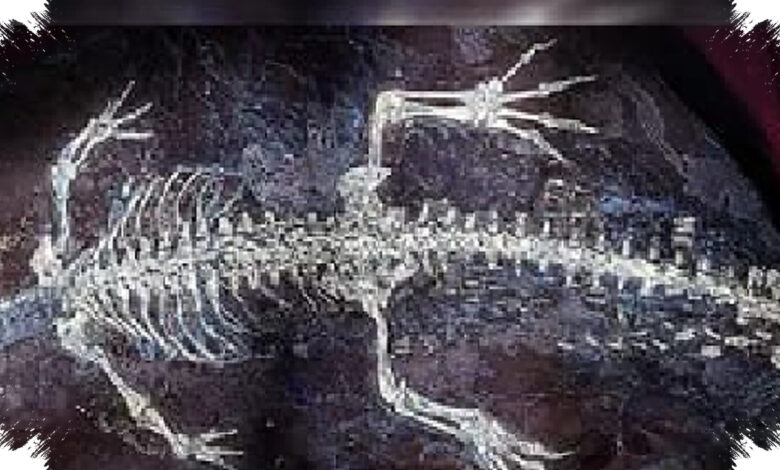
A 125-million-year-old fossil has preserved traces of skin, scales, and alternating light and dark bands along its tail. The pattern may indicate that markings seen on young crocodiles and alligators have exceptionally deep evolutionary roots.
The animal was Montsecosuchus, a prehistoric reptile measuring less than one metre long. Its unusually preserved soft tissues offer details that bones alone rarely provide in the fossil record.
The tail markings are among the most significant details revealed by the new examination. Researchers believe the light and dark bands may have formed stripes resembling those found in juvenile modern crocodilians.
Óscar Castillo-Visa, one of the study’s authors, said the tail pattern may not have been unique to Montsecosuchus. The possibility that such lines emerged early in the crocodilian evolutionary tree still requires further evidence.
Soft Tissue Reveals More Than Bone
The specimen came from the La Pedrera de Meià Formation in northeastern Spain. Although it was discovered and described in 1915, a more recent examination uncovered features that had remained hidden.
Researchers used ultraviolet light to inspect the preserved material. The method revealed remnants of skin, scale arrangements, and cartilage structures that are not visible through ordinary observation.
Skin tissue surviving for hundreds of millions of years is extremely rare. Its preservation gives scientists an opportunity to examine not only body shape but also aspects of how the animal may have looked in life.
| Body area or structure | Finding in Montsecosuchus | Possible significance |
|---|---|---|
| Arms | Smaller scales | Shows variation in scale arrangement |
| Neck and arms | Possible sensory organs | May reflect early limited distribution |
| Tail | No elongated upper ridge | Raises questions about swimming ability |
Questions About Life in Water
Montsecosuchus lived in an environment that was almost entirely aquatic, yet it lacked the elongated structure on top of the tail seen in modern crocodiles. That feature generally helps living crocodilians when swimming.
The absence of the structure has made its adaptation difficult to interpret. Castillo-Visa described the combination as puzzling because a small animal from a largely aquatic setting would be expected to possess an aid for swimming.
One possibility is that Montsecosuchus was not yet fully adapted as a swimmer and spent more time on land. However, its long-fingered hands and feet are commonly associated with animals living in aquatic environments.
The preserved tissues also show that its scales varied across the body. Scales on the arms were smaller than those on the legs, indicating that the animal’s outer covering was not uniform.
Possible sensory structures were found only on the neck and arms. In modern crocodiles, comparable organs can detect touch, water pressure, and temperature changes across nearly the whole body.
This contrast suggests that sensory organs in crocodilian ancestors may initially have developed in a more restricted pattern. They may have spread more widely across the body during later evolution.
Montsecosuchus therefore combines evidence of bone, skin, scales, sensory structures, and possible colour patterning in one valuable specimen. The fossil may help clarify how physical traits of crocodilians formed long before the species known today emerged.