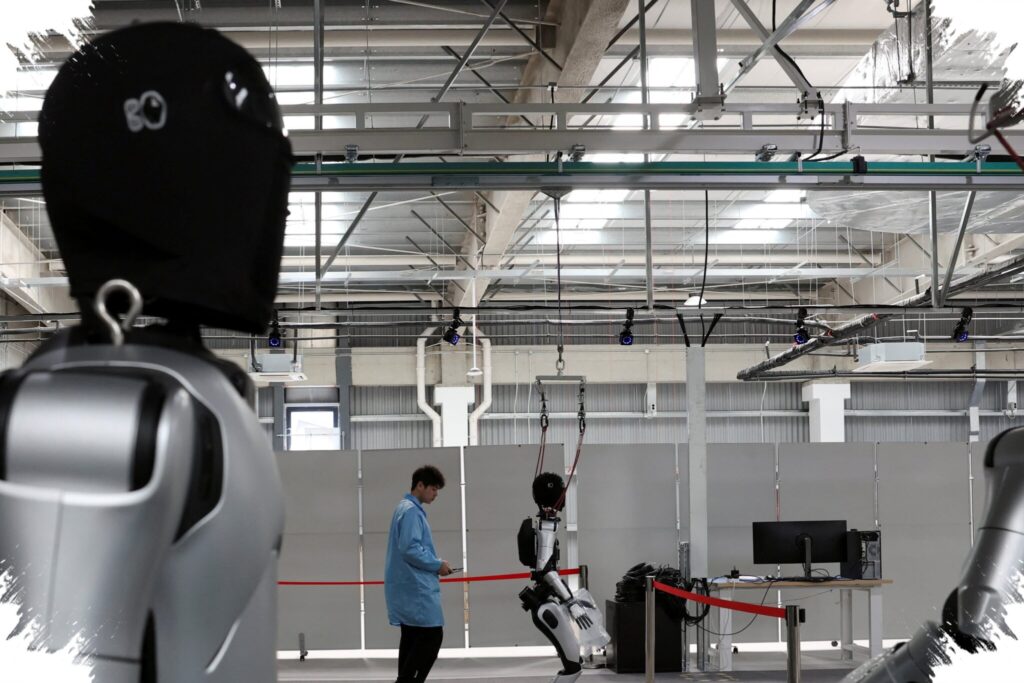
What happens when a humanoid robot moves beyond the lab and onto a real factory line is becoming easier to see in Nanchang, eastern China. At a tablet production facility there, four humanoid robots are now working eight-hour shifts in a high-precision assembly environment, handling final quality checks before devices leave the line.
The deployment reflects a broader shift in manufacturing, where embodied AI is starting to take on tasks that once depended mainly on people or conventional automation. Rather than standing as demonstration units, the robots are being used in a live production setting that demands speed, stability, and repeatable accuracy.
Precision work on a fast-moving line
One of the models in use is Genie G2 from AgiBot. Its job is straightforward in description but demanding in execution: it takes materials from a conveyor, places them into a testing box, and moves items that do not meet requirements to a separate window for staff pickup.
That process has long been difficult for rigid automation systems to handle. The robot combines visual perception with force control, allowing it to adjust to positional deviations of up to 1 centimeter while staying steady when dynamic disturbances appear on the production line.
The practical value lies in the robot’s ability to keep up with a factory rhythm that does not slow down for individual handoffs. In a mass-production environment, even small inconsistencies can disrupt output, which makes consistent handling a core requirement rather than a bonus feature.
Quick adaptation across product models
The Nanchang trial also shows that humanoid robots can adjust rapidly when a production line changes. Calibration takes only five minutes, while line switching and retraining are said to take no more than four hours.
That speed matters in modern factories, where product models can change often and output targets can shift quickly. Traditional automation usually requires longer reconfiguration when the task changes, which can limit flexibility and delay production transitions.
The robot’s performance in this setting suggests that humanoid systems may be better suited to environments where variability is part of the workflow. Instead of being locked into one fixed operation, the system can be adapted without long downtime.
Measured results from the factory floor
Field data from the Nanchang line shows that G2 completes one operation in about 18 to 20 seconds. It can process 310 units per hour and has recorded an overall success rate of more than 99.9 percent.
Those figures have drawn attention because they place humanoid robots in a category once reserved for highly controlled industrial systems. In practical terms, the data indicates that a robot can remain stable even in a high-speed production setting where precision is essential.
The application also extends the use case for humanoid robots beyond heavy or repetitive labor. Here, the task is not brute force, but careful handling and dependable consistency in an end-stage quality-control process.
From pilot projects to broader industrial use
AgiBot has already tested similar concepts elsewhere. Before the Nanchang deployment, the company trialed a wheeled robot with two arms at an automotive parts factory in Mianyang, in southwest China.
In that scenario, the robot was asked to identify pallets and containers on the factory floor, plan a route autonomously, and transport the containers to designated racks. The example adds another layer to the same trend: embodied AI is being positioned for warehouse-like movement as well as precision handling.
At Shanghai Longcheer, the G2 has reportedly been integrated into mass production for consumer electronics in just four months. Li Long, general manager of the robotics business division at the company, said the robot had operated continuously for 140 hours, and deployment at Longcheer is expected to rise to 100 units per quarter by the third quarter of 2026.
Yao Maoqing, senior vice president of AgiBot, said the fast rollout and potential return on investment may support wider adoption across consumer electronics, automotive, semiconductor, and energy sectors. In that view, humanoid robots are becoming production tools for repetitive tasks that require high accuracy, not replacements for the entire workforce.
The company’s market position also underscores the speed of its rise. According to an Omdia report released in January, the Shanghai-based robotics firm shipped more than 5,100 units per year and held 39 percent of the global humanoid robot market, ranking first worldwide in shipments and market share ahead of Unitree and UBTECH.
As more factories test these systems in real production conditions, China is increasingly using embodied AI not as a future concept, but as an active part of industrial work already happening on the line.