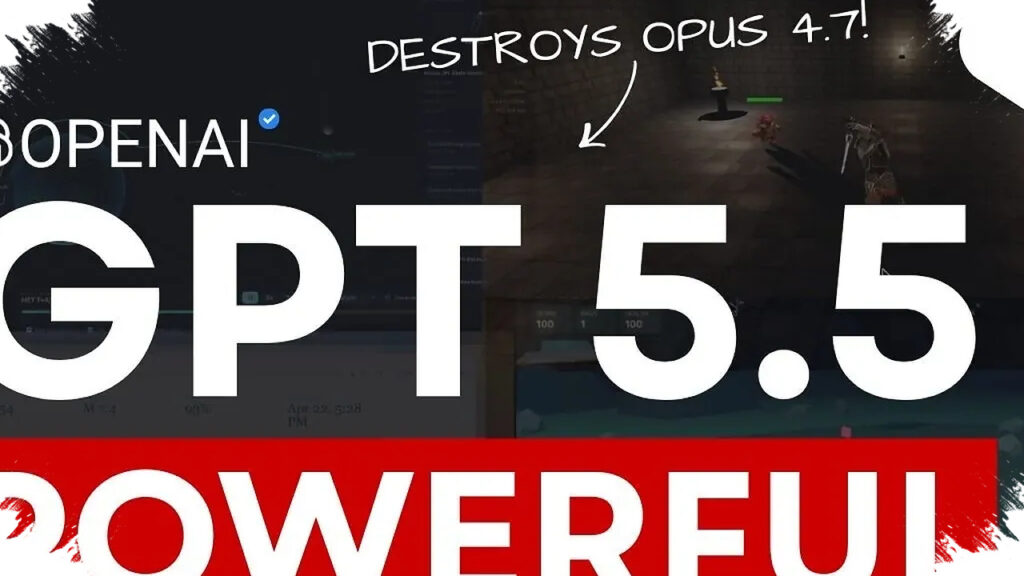
OpenAI has introduced GPT-5.5 with a sharper focus on multi-step computer work, signaling a broader push to make AI behave less like a chat tool and more like a work system that can carry tasks through on its own. The new model is aimed especially at agentic coding, but OpenAI says its scope goes beyond developers to cover anyone who works through a computer.
Greg Brockman, OpenAI president and co-founder, described the model as “no longer just for coders, but for anyone doing computer work.” That framing underscores how OpenAI wants GPT-5.5 to fit into everyday digital tasks such as writing and fixing code, researching information online, analyzing data, and preparing documents or spreadsheets.
Built for tasks that do not end in one reply
The main idea behind GPT-5.5 is not only to answer questions, but to take a messy request and move it toward completion. OpenAI says the model can plan the steps, use tools, check its own output, navigate ambiguity, and continue working until the task is finished.
That approach matters because AI competition is no longer judged only by answer quality. Increasingly, models are measured by how independently they can act inside a digital work environment and how useful they are in real computer-based workflows.
Agentic coding becomes the central battleground
OpenAI released benchmark data that it says shows GPT-5.5 outperforming earlier models as well as competitors from Google and Anthropic, including Gemini 3.1 Pro and Claude Opus 4.5. The biggest gains are reported in agentic coding, computer use, knowledge work, and early-stage scientific research.
In practice, agentic coding now goes well beyond producing code snippets. A model is expected to understand the goal, fix bugs, move across files, and complete technical tasks with less human direction.
OpenAI also argues that cross-context capability is becoming more important. For that reason, GPT-5.5 is positioned as a model better suited to work that needs sustained reasoning and execution over a longer stretch of time.
A product designed to move across tools
OpenAI says GPT-5.5 can shift between tools until a job is done, reducing the need for users to micromanage each step. That capability is central to the company’s broader vision of combining assistance, automation, and task execution inside a single environment.
Brockman, according to the TechCrunch report cited in the source material, framed GPT-5.5 as another step toward a “super app” that brings together ChatGPT, Codex, and an AI browser in one integrated service. The direction suggests OpenAI is aiming for a more unified layer of work software rather than a collection of separate products.
Competition with Anthropic is heating up
The launch also lands amid intense competition with Anthropic, whose Claude line has drawn major attention and commercial success. The source material notes that some GPT-5.5 features have direct counterparts, and in certain cases stronger rivals, in Claude 4.7 and Claude 5 Sonnet.
OpenAI still appears to retain a narrow edge because its model can work across browsers, files, documents, and computers while also understanding images, video, and audio. Anthropic, meanwhile, recently released Claude Opus 4.7 and announced Mythos Preview, a non-public model it says is highly advanced in cybersecurity.
OpenAI responded with GPT-5.4-Cyber, a model trained to flag cybersecurity vulnerabilities. The exchange shows how quickly the two companies are pushing into adjacent areas of capability, especially where work utility and technical precision overlap.
Faster release rhythm and wider rollout
OpenAI has also been moving quickly with product launches, maintaining a short release cycle that includes the latest model, another release last month, and earlier launches in December and November. The pace points to mounting competitive pressure and a stronger focus on products with higher business value.
At the same time, the company has reportedly trimmed several side projects, including the Sora video model, to concentrate more heavily on larger revenue drivers. GPT-5.5 is already being rolled out to Plus, Pro, Business, and Enterprise subscribers in ChatGPT and Codex, while GPT-5.5 Pro is available for Pro, Business, and Enterprise users.
OpenAI says the model is designed to reduce misuse while still keeping access open for useful work. Mia Glaese, a technical staff member at OpenAI, said the model will have a major impact on how the company applies models to digital defense, according to the TechCrunch report.