

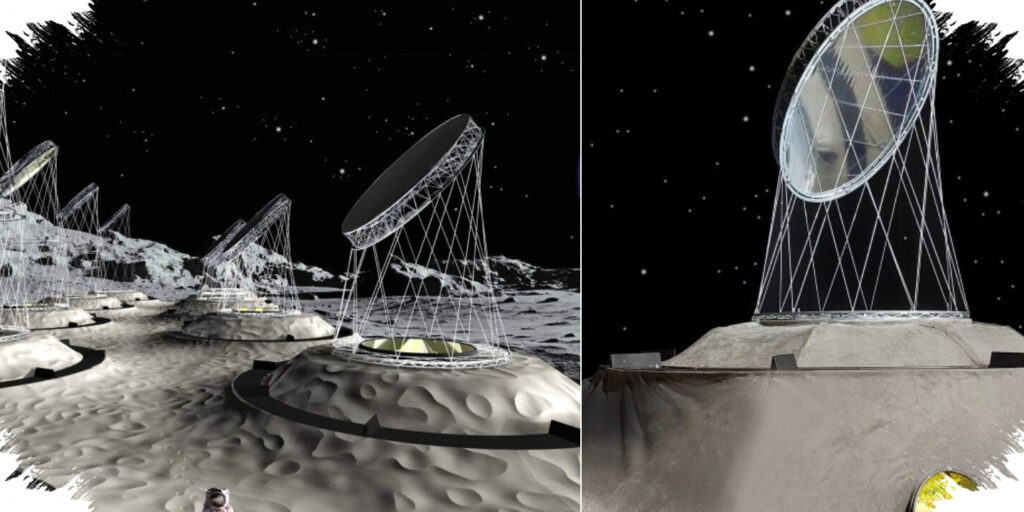
China is examining whether a greenhouse could eventually be built on the Moon, a concept aimed at supporting longer-term exploration and helping robotic systems cope with the harsh lunar environment. The idea remains in the research stage, but it reflects a broader shift in China’s lunar program from short visits toward more sustained operations.
The proposal was outlined by Wang Qiong, a senior space engineer at the China National Space Administration, during a press conference in Beijing. Wang said the study is part of construction technology research and is meant to address one of the Moon’s most difficult conditions: the extreme cold of lunar night.
Protecting equipment from the lunar night
A lunar night lasts about 14 days, and temperatures can fall to around minus 200 degrees Celsius. That creates serious risk for rovers, robots, and other surface systems that must survive long enough to keep working after sunset on the Moon.
In that context, a greenhouse is being considered not as a habitat in the immediate sense, but as a possible layer of protection for equipment operating on the surface. The purpose is to help future machines endure the sharp temperature swings that define the lunar environment.
Wang, who also serves as deputy chief designer of the Chang’e-6 mission, described the work as an important step as lunar exploration becomes more complex. The focus is no longer limited to brief missions and sample collection, but is moving toward systems that can support longer activity.
Link to Chang’e-6 scientific results
The greenhouse study was discussed alongside updates on the scientific return from Chang’e-6. According to Wang, analysis of the samples brought back by the mission has produced several important breakthroughs in lunar research.
He also said those samples have, for the first time, given a clearer picture of the evolutionary history of the Moon’s far side. That outcome strengthens the role of Chang’e-6 as a landmark mission in China’s lunar exploration program.
The return capsule from Chang’e-6 landed in northern China on June 25, 2024. The mission brought back 1,935.3 grams of samples from the far side of the Moon, marking the first time in human history that material from that region was returned to Earth.
International cooperation on board
Chang’e-6 also included international participation. Wang noted that the mission carried a CubeSat from Pakistan and three scientific payloads from France, the European Space Agency, and Italy.
He said those payloads achieved results that went beyond expectations. The mission therefore stood out not only for China’s technical progress, but also for the way it opened space for collaboration with foreign institutions.
That cooperation adds another layer to China’s lunar ambitions. While the country works on technologies that could help robots survive the brutal lunar night, it is also widening its scientific partnerships to strengthen the value of its missions.
A sign of longer-term lunar planning
The greenhouse concept shows how China’s Moon strategy is changing in scope. The main challenge is no longer only how to land and collect samples, but also how to build support systems that can last in a hostile environment.
If the research continues, the idea could become one part of a more stable lunar exploration framework for rovers, robots, and, in the future, possible human activity. For now, it remains a study, but it points to a future in which surviving the Moon’s night may matter just as much as reaching its surface.