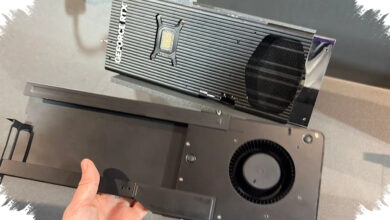
A PC gaming setup built entirely without Intel, AMD, or Nvidia components has now proven one important point: it can boot into Windows and run, but that does not make it ready for modern gaming. The test, conducted by GPUSpecs on YouTube, showed a fully functional system built around domestic Chinese hardware, yet the results were far from the level expected from a practical gaming machine.
What makes the experiment notable is not just that it works, but how much compromise remains. The system uses a Zhaoxin KaiXian KX 7000 processor and a Moore Threads MTT S80 graphics card, placing the entire build outside the mainstream PC ecosystem that most gamers still rely on.
A complete break from the usual PC platform


The KaiXian KX 7000 is an 8-core, 8-thread CPU with a boost clock of up to 3.6 GHz. On paper, that specification sounds reasonable for a modern desktop, at least for basic use.
The MTT S80 is the more ambitious part of the build. It comes with 4,096 MUSA cores, 16GB of GDDR6 memory, and an 1.8 GHz clock, while Moore Threads has positioned its performance around the RTX 3060 Ti level. The real-world testing, however, did not come close to supporting that comparison.
The CPU sits in a socket that is said to look very similar to LGA 1700. Even so, GPUSpecs noted that cross-compatibility with standard platforms appears unlikely.
Compatibility problems appeared early
The motherboard used for the build was made by Asus, which makes the system look familiar at first glance. Once the assembly began, though, RAM and driver compatibility issues appeared.
Despite those setbacks, the PC eventually completed the boot process and reached Windows. That result alone shows that a non-Intel, non-AMD, and non-Nvidia gaming PC is no longer just a theoretical idea.
Benchmarks expose the gap
In Geekbench, the KaiXian KX 7000 recorded a score of 789. GPUSpecs said that places it only slightly above half the performance of the Intel Core i5-7500 from 2017.
That result makes the CPU look modest even before gaming tests begin. For a platform meant to serve as the base of a gaming PC, the gap to mainstream performance remains large.
Game testing shows the limits clearly
The graphics card was unable to turn the system into a comfortable gaming rig. Forza Horizon 5 averaged 24.2 FPS at 1080p low settings, and its 1% low performance was even weaker.
Cyberpunk also ran, but only at an average of 22.3 FPS at 1080p low. Shadow of the Tomb Raider, despite being eight years old, reached just 21.3 FPS and reportedly fell into slideshow territory in 1% low results.
Grand Theft Auto V followed the same pattern. Even Black Myth Wukong, which is said to be optimized for the MTT, managed only around 13 FPS.
Some games would not run at all. Red Dead Redemption 2 and Spiderman Remastered failed to launch on the system.
Resident Evil 3 Remake came closest to being playable, averaging 44 FPS. Even there, the poor 1% low results still made the experience stuttery rather than smooth.
Cost still does not solve the problem
The price side of the build is not especially convincing either. The CPU and motherboard together are estimated at around $500, while the MTT S80 sells for about $300 on AliExpress.
That total does not include RAM, a case, a PSU, or an SSD. At that point, the build is neither cheap nor fast enough to justify itself as a gaming PC in the usual sense.
Even so, the experiment matters because it reflects the direction of China’s domestic hardware development. CPU and GPU progress in that ecosystem appears to be moving quickly, and the idea of a more competitive all-China gaming PC is no longer unrealistic.
For now, though, this system remains closer to a proof of concept than a finished product. It shows that alternatives to Intel, AMD, and Nvidia can already function, but stable modern gaming is still well out of reach.
Source: www.notebookcheck.net