


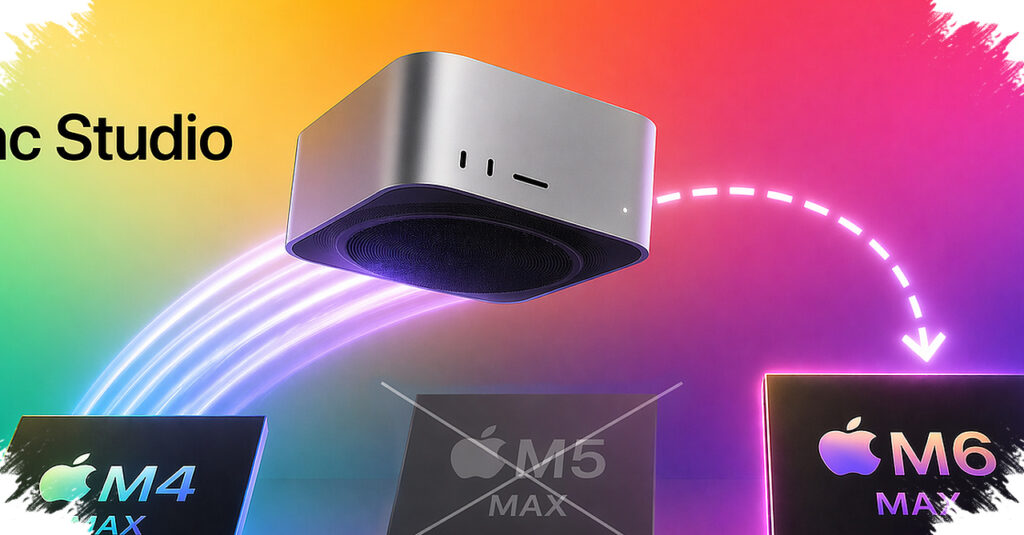
Apple’s next Mac Studio is now being pushed back, and the reason goes beyond product timing. Reports point to a broader shortage of high-performance memory, the same component family now under heavy pressure from AI infrastructure demand.
That delay is significant because the updated desktop is expected to be led by the M5 Ultra chip. Instead of arriving around the middle of the year, the latest schedule now points to October, with Apple still working to secure enough memory supply.
Memory supply is the main bottleneck
The slowdown has been linked to tight availability of high-performance memory. This part is especially important in advanced computing systems, including professional machines built for sustained heavy workloads.
AI expansion has made the situation worse. Server farms, data centers, and machine learning applications are all absorbing large amounts of memory, putting pressure on the wider technology supply chain.
Logistics issues around the world are adding another layer of difficulty. The result is not limited to Apple, since other hardware makers are also facing slower production and tighter product availability.
A launch window that keeps moving
Mac Studio was previously expected in the middle of 2026 and was even associated with WWDC at one point. The new timing now circulating points to October 2026 instead.
Apple is said to be continuing efforts to secure enough memory to support the launch. That means the company is not only dealing with a shifted schedule, but also with the risk of limited stock when the product finally reaches buyers.
The highest-end configuration is expected to be the most vulnerable to early shortages. For customers targeting specific specs, the first wave of pre-orders may matter more than usual.
M5 Ultra remains the main attraction
The biggest draw of the new Mac Studio is still its M5 Ultra processor. It is described as a major step up from M3 Ultra and is aimed at users who need serious computing power.
Apple’s Fusion architecture is also expected to play a central role. By combining two silicon dies, it is designed to improve performance and scalability for demanding workloads.
The focus is not simply on adding more cores. Apple is reportedly emphasizing better CPU and GPU efficiency, with the goal of delivering strong performance for video editing, 3D rendering, and AI development.
That points clearly to the intended audience. Creative professionals and developers working with AI-heavy applications are the users most likely to benefit from the upgrade.
A familiar exterior with a possible new finish
While the internal hardware is expected to change substantially, the outside of the Mac Studio is said to remain the same. Apple appears to be keeping the current form factor because it is still considered practical for a professional desktop.
There is also a rumor about a space black color option. That detail would be cosmetic rather than functional, but it could still matter to users looking for a different look on their desks.
Keeping the existing design also reinforces the product’s priorities. In a workstation category, many buyers care more about computing power and stability than about a redesigned shell.
Ripple effects may reach other Apple products
The memory shortage is not isolated to Mac Studio. Other Apple products could also be affected if the supply situation does not improve soon.
One device mentioned in the same context is the MacBook Pro with its anticipated OLED update. That model could also face delays or limited availability if the pressure on supply chains continues.
The broader picture shows how AI demand is reshaping hardware priorities. Memory that once supported premium consumer devices is now also being pulled into data centers and server infrastructure, leaving less room in the supply chain for high-end desktops.
For Apple, that creates a familiar but increasingly difficult problem. Even a flagship workstation can be slowed down when the components it depends on are being competed for across the entire technology industry.