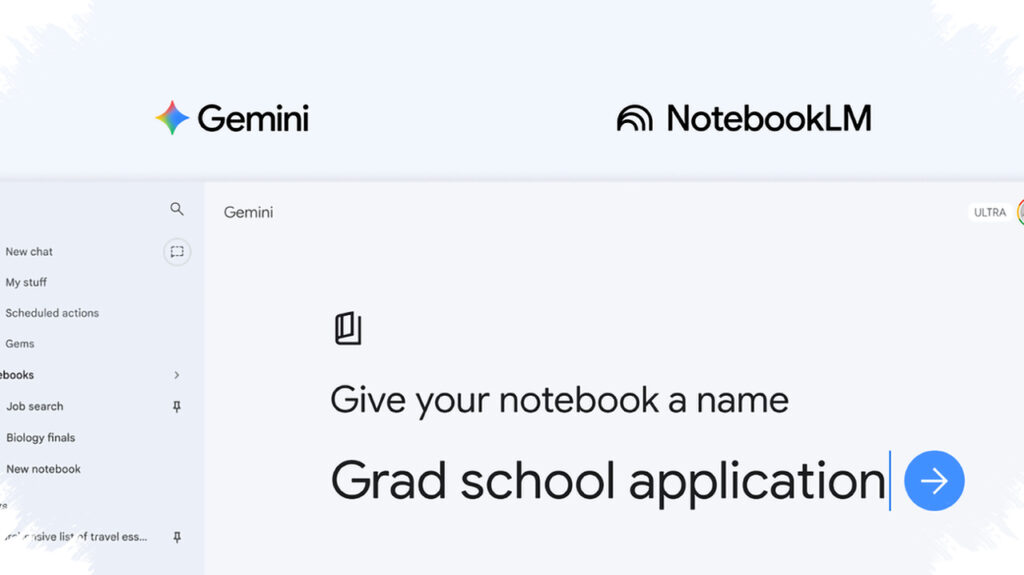
Google has made Gemini’s notebook feature much easier to reach by opening it to all users in the mobile app. What had been a more limited capability is now available to both free and paid accounts, turning Gemini into a more complete workspace for research and project-based work.
The change matters because notebooks in Gemini are not just a place to store chats. They are designed to combine conversations, documents, and supporting sources in one organized space, giving users a more structured way to work on information-heavy tasks.
A tighter link between Gemini and NotebookLM
The expansion also marks another step in Google’s growing integration between Gemini and NotebookLM. These are two of Google’s AI services that have stood out for information-based workflows, and their connection has been building for months.
The first move came in mid-December, when Google brought NotebookLM to Gemini. At that stage, support was limited to the web. Support later reached the mobile app, and then in early April Google deepened the connection further by adding notebooks directly into Gemini.
How notebooks work inside Gemini
In practice, a notebook in Gemini works somewhat like a folder for conversations, but with more intelligence behind it. Users can group chats together and add related files and documents so Gemini has extra context to work from.
That setup is especially useful for people using Gemini for research. A single notebook can hold the conversations and documents tied to one project, making it easier to keep work organized in one place.
Free users get access, but limits remain
Google had initially given priority access to paying AI subscribers when the feature first arrived in April. In that announcement, the company said notebook support would expand to free users, mobile devices, and more countries in the following weeks.
About three weeks later, NotebookLM’s account on X said notebooks in the Gemini app were now available to all free and paid users on mobile. The result is that a feature once reserved for a narrower group is now becoming part of the main Gemini experience.
There is still a clear difference between free and paid plans. On the free tier, each notebook is limited to 50 sources, while Google AI subscribers can add between 100 and 600 sources per notebook, depending on the plan.
That gap matters most for larger research projects. More sources mean more context for Gemini and NotebookLM to process, while the 50-source limit still covers many basic needs for everyday users.
Rollout is still not complete everywhere
Google has also said notebook support in Gemini is not yet available in all European countries. The company said availability in those markets is coming soon, which shows the rollout is still moving in stages.
Even so, the broader direction is clear. Google is steadily pushing the feature beyond its initial limits and into more of Gemini’s core experience on mobile.
The notebook expansion comes shortly after another practical upgrade to Gemini. Just days earlier, Google added file creation support to the chatbot, letting users export research into formats such as PDF, Word, PowerPoint, Markdown, Rich Text Format, and others.
Together, the notebook feature and file export support point to the same goal. Google appears to be shaping Gemini into more than a chatbot, with a stronger focus on collecting sources, organizing work, and turning results into usable files.
Source: www.androidpolice.com