


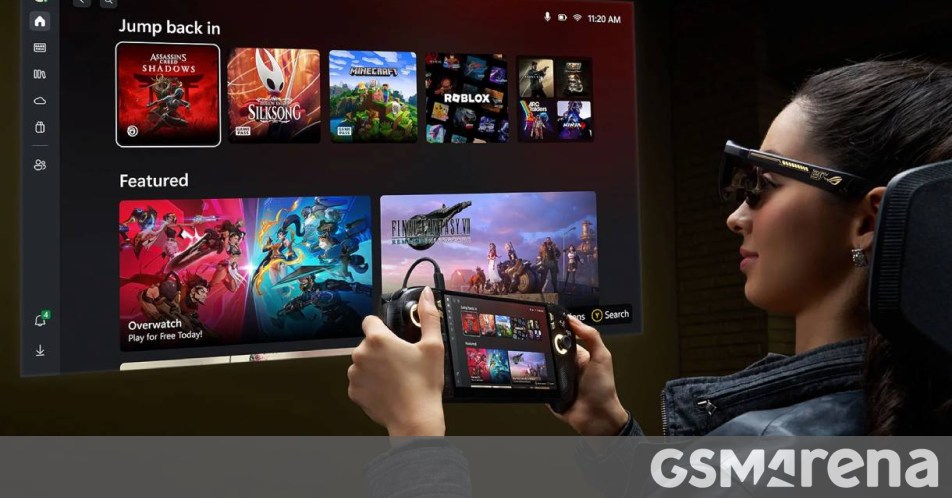
Asus has taken a sharp approach with the ROG Xbox Ally X20: instead of chasing a faster chip, it is targeting the two complaints that matter most to handheld gamers, the display and the controls. The problem is that the fix arrives in a premium bundle, and the added ROG Xreal R1 Edition 20 glasses may push the package far beyond what many players want to spend.
The most visible upgrade is the move to a 7.4-inch OLED panel with a 1,920 x 1,080 resolution and a 16:9 aspect ratio. Compared with the 7-inch LCD on the previous Ally X, the new screen also expands variable refresh rate support from 30Hz to 120Hz, which should make gameplay feel smoother across a wider range of frame rates.
Brightness is another major step up. Asus lists the new display at 1,400 nits, well above the 500 nits of the Ally X, while VESA DisplayHDR TrueBlack 1000 and Dolby Vision support are also included. The panel is still protected by Gorilla Glass Victus with an anti-glare GG DXC layer, keeping the device aimed at users who want stronger contrast and better visibility in different lighting conditions.
A new focus on controls
The joystick update is equally important, even if it is less flashy than the OLED panel. Asus has replaced the old sticks with TMR sensors, a technology that is increasingly positioned as an alternative to Hall effect designs and is intended to reduce the risk of stick drift.
Other control changes are more subtle but still practical. The ABXY buttons now sit flush with the body when pressed, and the D-pad can be switched between 4-way and 8-way modes. That gives the handheld more flexibility depending on whether the user prefers precision inputs or broader directional control.
Performance remains familiar
For all the display and control upgrades, the core performance package does not change. The ROG Xbox Ally X20 still uses AMD’s Z2 Extreme, with 8 cores, 16 threads, boost speeds up to 5.0GHz, 24MB of cache, and 16 graphics cores.
Memory and storage are also carried over without changes. The device comes with 24GB of LPDDR5X RAM, a 1TB NVMe PCIe 4.0 SSD in M.2 2280 format, and adjustable power limits from 15W to 35W. In other words, Asus is not trying to make this model a leap in raw computing power.
The bundle is where the price tension appears
The “X20” name marks 20 years of Republic of Gamers, but the product strategy is what makes it unusual. Asus is not presenting the handheld as a standalone device here, because it is bundled with the ROG Xreal R1 Edition 20 AR glasses.
Those glasses are built around a 171-inch virtual display with a 57-degree field of view. They use a 1,920 x 1,080 micro-OLED panel, a 240Hz refresh rate, and a 0.01ms response time, while electrochromic lenses offer three dimming levels to help cut ambient light.
Connectivity for the glasses is straightforward. They can connect to the Ally with a single USB-C cable, or through the ROG Control Dock, which provides two HDMI 2.0 ports and one DisplayPort 1.4. That setup makes the accessory more versatile, but it also raises the stakes for the overall package.
Pricing is the main concern. The Xreal R1 Edition 20 is said to sell separately for $850, while Asus has not yet announced the official price of the ROG Xbox Ally X20 bundle. With no separate handheld option mentioned, the package feels tailored to premium buyers rather than to users who only want the upgraded console.
Bigger body, same battery
The hardware changes also have a physical cost. The ROG Xbox Ally X20 measures 300 x 121 x 27.5-51.3 mm and weighs 756 grams, making it larger and heavier than the Ally X, which comes in at 290 x 121 x 27.5-50.9 mm and 715 grams.
Even so, Asus keeps the rest of the feature set broad. The handheld includes one USB-C 3.2 Gen 2 port with DisplayPort, one USB-C 4.0 port with Thunderbolt 4 and DisplayPort 2.1 with FreeSync, a 3.5 mm headphone jack with Hi-Res Audio, Wi-Fi 6E tri-band, Bluetooth 5.4, and a microSD Express slot.
Audio and battery capacity are also unchanged from the prior model. Stereo speakers with Dolby Atmos remain on board, the battery is still rated at 80Wh, and charging support goes up to 68W over USB-C.
Source: www.gsmarena.com