


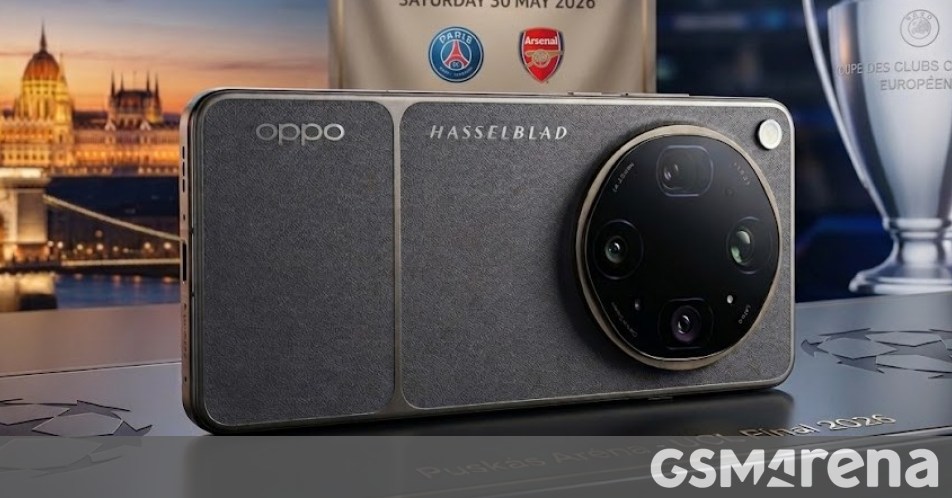
The most striking part of Oppo’s Find X9 Ultra camera showcase is that it was not confined to controlled conditions. Instead, the phone was taken through Budapest during the UEFA Champions League final, where it had to handle historic streets, dim interiors, night scenes, fan activity, and match action in a single stretch.
That makes the shoot feel less like a standard product test and more like a real-world stress test. Every image was reportedly captured directly from the phone in its default JPG format, with no extra processing added, so the results reflect how the camera performed across very different scenes.
A city built for a difficult camera test
Budapest provided a wide range of subjects before the final even began. Fisherman’s Bastion offered a sweeping view over the city from higher ground, making it a fitting spot for landscape work and architectural detail.
The route then moved to St. Stephen’s Basilica, the largest church in Budapest. Its grand interior also comes with lower light, which made it a useful setting for seeing how the Find X9 Ultra handled darker spaces without added processing.
Liberty Bridge added a different kind of challenge. With a yellow tram passing through the frame, the scene introduced a more street-photography style composition and a moving subject.
The visual tour continued along the Danube, where the Hungarian Parliament Building stood out under dramatic night lighting. That shift from daylight landmarks to illuminated city scenes helped show how the phone dealt with contrast and atmosphere.
From fan festival to fast-moving action
The final weekend in Budapest was not only about the stadium. UEFA’s Champions Festival brought football-themed activity to the city, giving the camera additional subjects beyond buildings and sightseeing spots.
One highlight of the festival was a 5v5 exhibition match featuring Claude Makelele and Arsenal legend Theo Walcott. That mix of static city scenes and quick sports movement created a broader test of the phone’s speed and flexibility.
It also mattered because the camera was not only being asked to photograph still objects. The variety of subjects made it easier to judge how well it could shift from festival atmosphere to action in motion.
Teleconverter use during the final
When the match moved to Puskas Arena, the focus turned to the game itself. A 300mm teleconverter from the Earth Explorer Kit was said to be used for most of the photos and video, pushing the camera setup toward distant and fast-moving subjects.
The final opened with a pre-match performance from The Killers before PSG and Arsenal took the field. Arsenal went ahead early through Kai Havertz in the sixth minute, but PSG kept pressing for an equaliser.
There was also a moment of controversy when PSG appealed for a penalty after the ball struck Bukayo Saka’s hand following a poor clearance attempt. The referee judged the contact to be unintentional, so no penalty was awarded.
Penalty tension and the closing moments
PSG’s pressure continued into the second half and eventually produced a spot kick. Cristhian Mosquera was judged to have fouled Khvicha Kvaratshkelia in the box, and Ousmane Dembele converted past David Raya to level the score.
From there, Arsenal stayed organised and limited clear chances, but the match could not be settled in normal time. The final therefore moved to a penalty shootout, where the camera’s long-range setup was again put to work from the stands.
Raya made an important save after Eze’s effort, but Gabriel then sent the tenth penalty over the bar. That result kept the trophy in Paris for another year, while the shootout and the later trophy presentation gave the camera one last set of high-pressure moments to capture from a distance.
Source: www.gsmarena.com