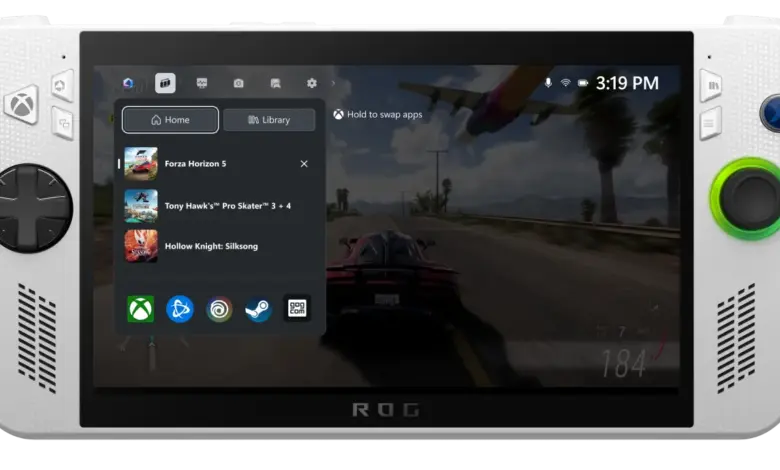
For buyers who want a handheld PC mainly for local AAA gaming, the older ROG Ally still makes a stronger case than the new ROG Xbox Ally. The reason is simple: the newer model does not lead in raw performance, which is still the most important factor for demanding PC games.
That contrast is the core of the comparison. ROG Xbox Ally uses Ryzen Z2-A, while the original ROG Ally 2023 is powered by Ryzen Z1 Extreme, and the older device is the faster one for heavy gaming workloads.
Performance still favors the older Ally
The gap begins at the chip level. Ryzen Z2-A comes with a quad-core Zen 2 CPU and an 8 compute unit RDNA 2 GPU, while Ryzen Z1 Extreme offers an 8-core Zen 4 CPU and a 12-core RDNA 3 GPU.
That difference puts the original ROG Ally in a clearly higher performance class despite being the older product. Its stronger CPU and larger GPU make it the better fit for players who want to run modern PC games locally with higher frame rates.
For titles such as Cyberpunk 2077, Black Myth: Wukong, and even upcoming large games like The Witcher 4, the extra headroom of Z1 Extreme is expected to matter. In aggressive settings with AMD FSR, the original Ally is still said to target 40-60 FPS in many cases.
ROG Xbox Ally, by contrast, is expected to struggle to hold 30 FPS under similar conditions. That makes it harder to recommend for players who see a handheld as their main machine for demanding games.
Where ROG Xbox Ally does make sense
The newer device is not without strengths. ASUS increased the battery from 40Wh on the older ROG Ally to 60Wh on ROG Xbox Ally, and the more efficient chip should help extend playtime.
That gives the new model a better fit for lighter but longer sessions. Indie games, emulation, and cloud gaming are the kinds of use cases where its design has more appeal.
It also benefits from a more Xbox-like grip shape, which should feel familiar to users who prefer a controller-style hold. On the software side, the Xbox UI built on Windows is meant to be smoother and easier to navigate.
Even so, those improvements do not erase the fact that the chip carries fewer CPU cores and a weaker GPU. For players focused on local performance, convenience alone is not enough to offset that trade-off.
Price changes the equation further
The pricing gap makes the comparison even more one-sided. ROG Xbox Ally is said to cost around 60,000 rupees, while the original ROG Ally is listed at 39,999 rupees on the ASUS official store.
At that level, the older model offers a better price-to-performance ratio. It is also described as one of the most powerful handheld gaming PCs in its class, which helps explain why it remains relevant even with newer hardware on the market.
If fresh stock is harder to find, the second-hand market is mentioned as the most effective way to buy the original ROG Ally. Another option in the same family is a used ROG Ally X, which could also be worth considering for buyers looking near the Xbox Ally’s price range.
Which one fits which user
The decision depends on how the device will be used. For local AAA gaming and the highest possible frame rates, the original ROG Ally with Ryzen Z1 Extreme is the more rational choice.
ROG Xbox Ally fits a different audience. It is better suited to users who care more about battery life, a more practical handheld experience, and lighter workloads such as cloud gaming or emulation.
That is why the older model ends up looking like the smarter buy for performance-first gamers, while the newer one makes more sense for those who value endurance and ease of use over raw gaming power.
Source: tech.sportskeeda.com