


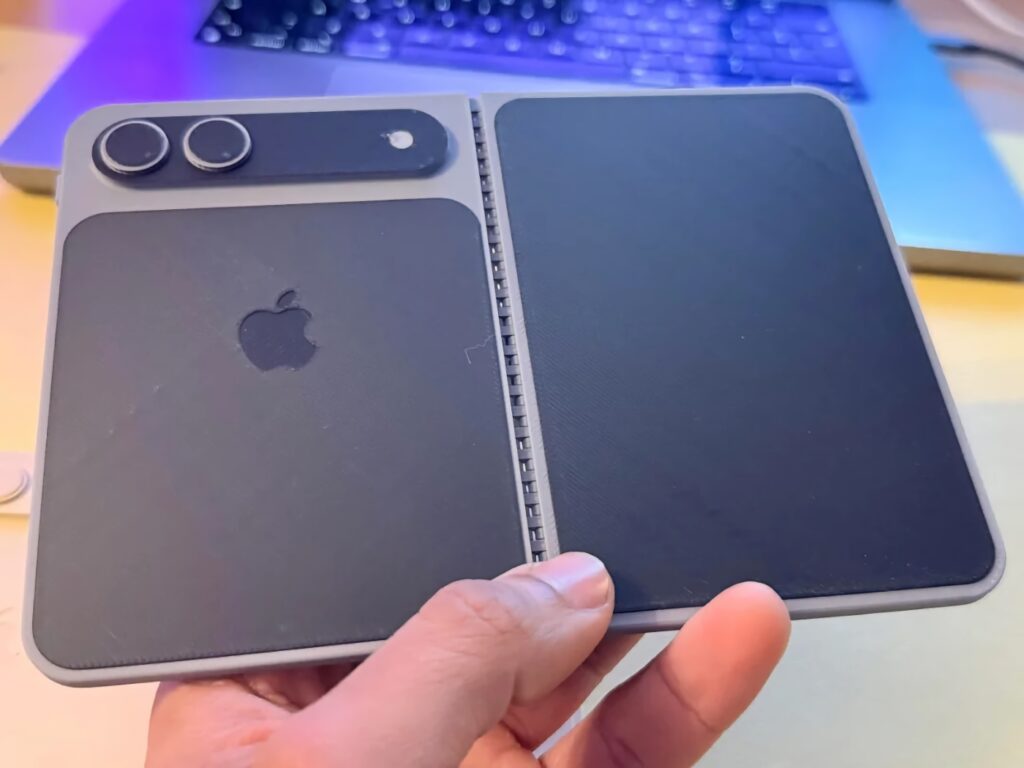
Apple’s first foldable iPhone is starting to take shape through a set of dummy units, and the clearest message from the latest leak is that the company appears focused on the two details that matter most in this category: the hinge and the screen crease. Rather than trying to copy a standard iPhone layout, the device seems to follow a book-style foldable design that aims for a different kind of experience.
Images shared by gadget leaker Sonny Dickson show a form factor that opens like a book, a format long associated with Android foldables. When closed, the body looks shorter and wider, with proportions closer to a passport-style shape than a typical slab phone.
A larger inner display, paired with a compact outer screen
The dummy unit points to a main display of around 7.8 inches when unfolded. On the outside, the cover screen is said to measure about 5.5 inches, giving users a smaller panel for quick tasks when the phone is not fully opened.
That sizing suggests Apple is not chasing a closed-device look that fully resembles a regular iPhone. Instead, the design appears aimed at balancing handheld comfort with efficient use of the foldable body.
Camera placement keeps the inside display clean
The rear design shown in the leaked unit includes an elongated capsule-shaped camera module. It sits on the left side of the back panel and holds two horizontal cameras, while the flash is placed on the right side.
For the inner display, the front camera is reported to be positioned in the top-left corner. That placement indicates Apple wants the main folding screen to remain as visually unobstructed as possible during use.
Touch ID may replace Face ID
The leak also points to an important security change. The iPhone Fold is said to skip Face ID and instead use Touch ID integrated into the power button.
That sensor would serve both device unlocking and Apple Pay verification. In a foldable design with more complex internal space and hinge mechanics, a side-mounted fingerprint solution may be a practical choice.
The hinge may be the real headline
Beyond the shape and camera layout, the biggest attention appears to be on the hinge itself. Several reports suggest Apple is aiming for a foldable where the screen crease is nearly invisible when the device is opened.
That matters because crease visibility remains one of the most common trade-offs in the foldable phone market. Even as display technology improves, the center line is often still noticeable or at least tangible during use.
If Apple can reduce that effect more effectively than rivals, it would give the device a strong point of difference. For many buyers, the feel of a fully opened folding display is a major measure of whether the phone feels premium or still compromised.
Color options remain limited and uncertain
Color details are still unclear, but Sonny Dickson believes Apple may launch the device with only one option at first: white. That view differs from an earlier Bloomberg report by Mark Gurman, who said the phone would arrive in black and white.
The split in those reports shows that final product details are not fully settled yet. A limited color lineup would not be unusual for a first-generation Apple product, especially if the company wants to simplify early production and test market response before widening the range later.
Apple has not officially confirmed its first foldable iPhone, but the dummy units suggest a clear direction. The device appears to be built as a book-style foldable with a large inner screen, a smaller cover display, dual horizontal rear cameras, Touch ID in the power button, and a major emphasis on hinge quality and minimal crease visibility.
Source: tekno.kompas.com