


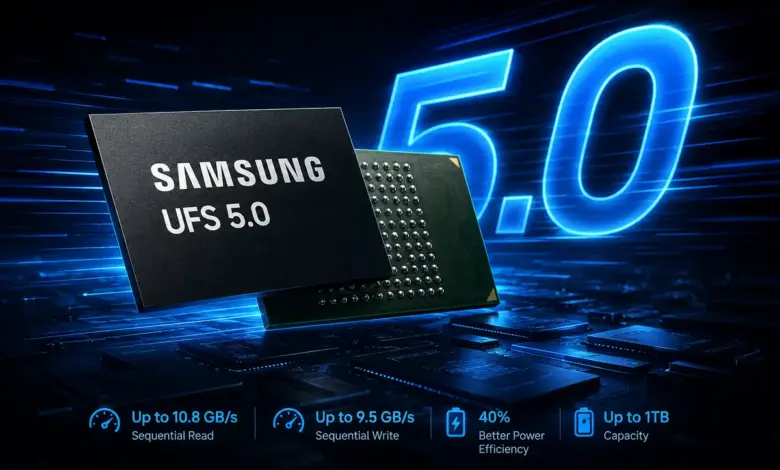
Samsung’s next mobile storage standard is designed to do more than move files faster. With UFS 5.0, the company is aiming at the part of a phone that now matters just as much as capacity: how quickly the device can handle AI, apps, and heavy data tasks.
Samsung says UFS 5.0 can reach read speeds of up to 10.8 GB/s and write speeds of up to 9.5 GB/s. That is roughly twice as fast as its UFS 4.1 solution, a jump that could matter most on premium Galaxy phones.
Built for on-device AI
The new standard is being positioned as a foundation for on-device AI, where speed and low latency directly affect how smoothly a phone works. Samsung says UFS 5.0 is intended to help move and process large data more quickly for AI tasks running locally on the device.
That includes faster responsiveness for large language models, or LLMs. In practical terms, lower latency and shorter response times can improve how quickly a phone loads models, accesses data, and reacts to user prompts.
This matters because modern AI features increasingly rely on local processing rather than cloud-only support. As storage becomes faster, the device has more room to keep those experiences responsive without waiting on slower memory access.
More efficient, smaller, and easier to fit
Performance is not the only part of the pitch. Samsung also claims UFS 5.0 improves power efficiency by more than 40% compared with UFS 4.1.
That kind of gain is important for smartphones that already juggle demanding workloads such as AI and multitasking. A more efficient storage system can help balance speed and battery pressure more effectively than the previous generation.
The company also says the new storage is 16.7% smaller in physical size. That gives handset makers more room to work with inside slim, densely packed devices.
Samsung says the smaller footprint also makes UFS 5.0 suitable for wearables and XR devices. Those categories benefit from compact components as much as they benefit from lower power use.
Flagship timing points to future Galaxy models
Samsung is targeting mass production of UFS 5.0 in Q4 2026, with capacities planned up to 1TB. The schedule suggests that commercial adoption is still a step away, even as the company lays the groundwork early.
The new standard is aimed at flagship phones, which fits the kind of workloads that push storage hardest. High-end devices need more bandwidth for cameras, games, large apps, and the increasing number of AI-driven features.
The launch has also fueled speculation about the Galaxy S27 series. A report from mid-April previously said Samsung was moving toward integrating UFS 5.0 into the Galaxy S27 lineup.
That same report suggested the upgrade may not reach every model in the series. It said only “some” Galaxy S27 devices are likely to use UFS 5.0, leaving open the question of which version gets it first.
For now, Galaxy S27 Ultra is the model most often expected to adopt the new storage. Pricing is another factor Samsung is said to be weighing before deciding how broadly to roll out the upgrade.
Even without a final product list, the direction is clear. Samsung is preparing a storage standard meant to make future Galaxy phones feel faster in everyday use, while also supporting the heavier AI workloads that are becoming central to the next wave of mobile devices.