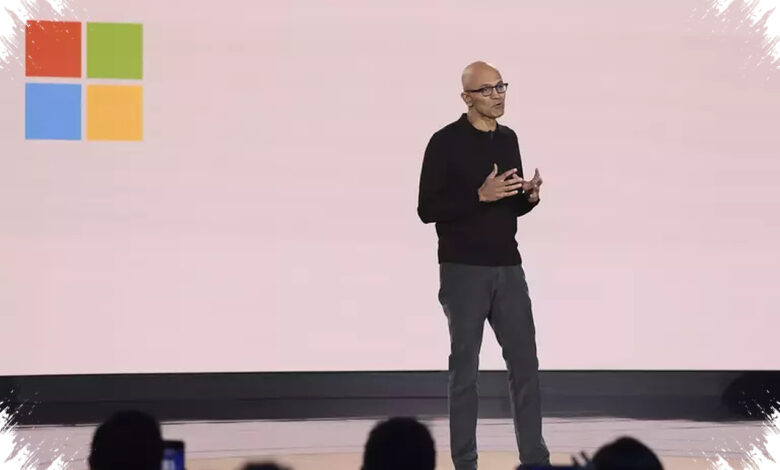
Microsoft CEO Satya Nadella has raised a warning that cuts to the core of how companies now use artificial intelligence. In his view, AI is not just a faster and cheaper work tool, but a system that can quietly absorb a company’s most valuable internal knowledge.
The warning centers on what Nadella calls the reverse information paradox. The idea is simple but unsettling: to get the best results from AI, companies often have to expose the very documents, workflows, and institutional knowledge they want to protect.
When better AI performance demands more private knowledge
Nadella linked his argument to economist Kenneth Arrow’s Nobel-winning theory about information markets, where the value of information is hard to prove without revealing it first. In the AI era, he said, that logic has effectively flipped.
Companies now pay twice, according to Nadella. They pay for the AI system itself, and they also pay with proprietary knowledge that must be shared for the model to become truly useful.
“You are essentially paying for intelligence twice, once with money and once with something much more valuable, which is the proprietary knowledge you have to reveal for that intelligence to be useful. The better the model performance you want, the more knowledge you have to give,” Nadella said, as quoted by TechCrunch on Tuesday (14/7/2026).
The hidden trail AI leaves behind
Nadella said the biggest risk is not limited to the files uploaded into a model. It also comes from the trail created during everyday use, which he described as AI exhaust.
That exhaust includes prompts written by employees, tools called by AI agents, and the corrections workers make when a model gives the wrong answer. In Nadella’s view, each correction becomes institutional knowledge that is gradually filtered into the system.
He argued that this creates an uneven relationship between AI vendors and their customers. The provider keeps learning from the client’s business, while the client never fully knows what the provider has learned in return.
A closer look at the two risks Nadella highlighted
| Term | Meaning | Impact on Companies |
|---|---|---|
| Reverse Information Paradox | Buyers must reveal their own knowledge for AI to be useful | Internal information assets may be exposed |
| AI Exhaust | Prompts, tools invoked by AI agents, and user corrections | Every interaction can become a source of model learning |
Microsoft’s critique of uneven AI rules
Nadella also questioned what he sees as a double standard in the AI industry. He acknowledged that model developers need legal protection, including fair use principles, to train systems on public internet data.
But after a model is built, some providers restrict distillation, the practice of learning from a model’s outputs to train a smaller or cheaper one. In February, Anthropic accused a Chinese open source model of sending millions of requests to Claude in order to study its behavior.
Anthropic also urged the U.S. government to tighten controls on AI technology exports. Nadella said this kind of policy tension shows how uneven the competitive field has become.
He also questioned the way some AI companies reserve the right to study customer usage and interaction data while limiting what others can do with their own models.
If learning flows in only one direction, Nadella suggested, the value will concentrate in the companies that own the AI infrastructure rather than in the businesses that generate the knowledge.
The 5C framework for keeping control of AI knowledge
To reduce that risk, Nadella proposed a 5C Framework that he said can help companies keep control of AI learning. The first is control, which means building internal evaluation systems and owning the memory, usage trail, and user feedback tied to AI.
The second is capability, or training and refining models inside a company’s own cloud environment. The third is choice, which involves creating an orchestration layer so a company can move between models without losing the capabilities it has already built.
The fourth is cost, because an orchestration layer can help firms choose the most efficient model for each task. The fifth is compound, meaning AI learning should keep improving without handing institutional knowledge to an outside vendor.
“In consuming intelligence, you are also creating intelligence. And what you create should be yours,” Nadella concluded.
Why open source models are gaining attention
Nadella did not present open source as the only answer, but many companies are already moving in that direction. Some are running models in their own infrastructure or on-premises so data can remain inside the company’s environment.
Idit Levine, founder and CEO of Solo.io, said many customers first tried proprietary AI models before realizing the risks and the cost. They then began looking at open source models that could run locally.
“Can I take an open source model and run it on-prem? The model can do almost 90% of what the big models do at a much lower cost. They understand it, and they can control it,” Levine said.
Solo.io is a networking and security software company that helps organizations manage AI systems. Its technology was chosen as the foundation for the Linux Foundation’s project agentgateway, and its customers include T-Mobile, ADP, and SAP.
Usage trends at Vercel and OpenRouter point in the same direction. Both companies, which provide AI model routing services, have reported a rise in open source model use, and Vercel said open source models accounted for about 29% of all AI traffic passing through its gateway last month.
Microsoft’s warning matters because the company is one of OpenAI’s biggest investors and also has business ties with Anthropic. As AI adoption accelerates, Nadella’s message is that companies should make sure the knowledge created through AI use remains their own.