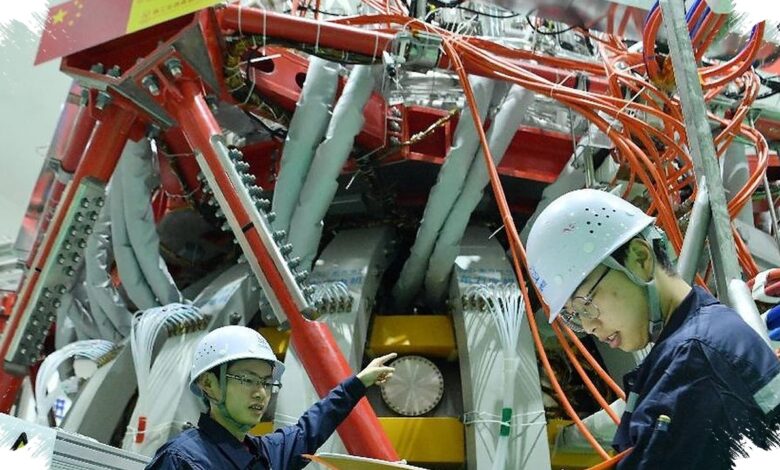
China’s push toward practical fusion power has entered a more decisive phase. The EAST experimental reactor, often called an “artificial sun,” is now being prepared for electricity generation around 2030.
The latest progress comes after two domestically made superconducting magnets for the reactor passed technical tests and full-load evaluation. That milestone strengthens China’s case for building its first fusion nuclear power plant.
Core components pass a major test
According to CCTV, as cited by Global Times, the two main superconducting magnets for EAST have reached the final stage of development and full-parameter testing. The achievement is being described as a complete localization of the project’s core technologies.
Qin Jinggang, deputy director of the Institute of Plasma Physics under the Chinese Academy of Sciences, said his team was given two goals six years ago: improve performance and reduce costs. After six years of research and development, the team says it has significantly and steadily improved performance while also building a supply chain and production equipment.
| Component | Key Data | Impact |
|---|---|---|
| Superconducting magnet | Passed technical tests and full-load evaluation | Entered the final development stage |
| Tested coil | Weight increased from 350 tons to 580 tons | Supports operation at higher energy levels |
| Superconducting material cost | Down from about 400 yuan to 100 yuan per meter | Sharp reduction in production cost |
The cost of superconducting material has also fallen sharply. Qin said the price, once about 400 yuan per meter, has dropped to around 100 yuan per meter.
The newly tested coil also represents a major scale jump. Compared with the previous design, its weight rose from 350 tons to 580 tons, along with increases in size and energy storage capacity.
What remains before the finish line
Qin said the larger scale opens the door for fusion devices that can operate at much higher energy levels. Even so, he stressed that the latest test covers only 80 percent of the project’s journey.
The next challenge is installing the coil inside the device and testing its long-term stability and lifespan under extremely demanding operating conditions. Only after that stage is passed, he said, can China truly claim to have fully mastered high-temperature superconducting technology.
For EAST, the remaining work matters because the reactor has already set records. In January 2025, it maintained a plasma temperature of 100 million degrees Celsius for 1,066 seconds, breaking a world record.
That achievement helped underline why superconducting magnets are seen as one of the hardest barriers on the path to practical fusion power. The effort is also the result of multi-generational research by Chinese scientists since the 1980s.
Qin said fusion nuclear energy remains one of the hardest technologies to master, but after decades of work, a clearer path is emerging. The target has not changed: demonstrate the first electricity production from nuclear fusion around 2030.