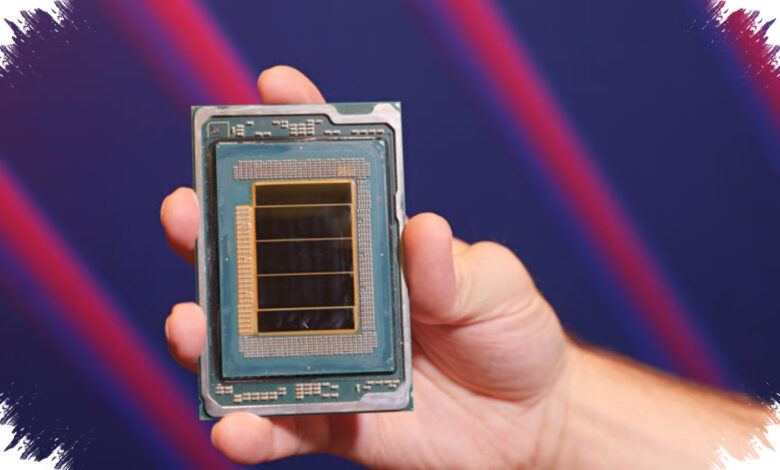
Intel is preparing the Starfire system-on-chip to bring artificial intelligence processing directly into satellites and spacecraft. The design is intended to let orbiting systems filter data and make local decisions before waiting for a transfer to computing facilities on Earth.
That capability matters for missions dealing with communication delays and large volumes of instrument data. Processing data near its source can help a spacecraft decide what should be transmitted while handling AI work in real time in orbit.
AI Performance in Two Power Classes
Starfire will be offered in two configurations with distinctly different power targets. The low-power version has a 10W TDP, while the performance version is rated at 35W.
Intel plans to ship chip samples in the third quarter of this year. Both versions use an eight-core CPU built on the Intel 18A process, combining four performance cores with four efficiency cores.
| Configuration | TDP | P-core speed | E-core speed |
|---|---|---|---|
| Low power | 10W | 1.0 GHz | 850 MHz |
| Performance | 35W | 3.1 GHz | 2.1 GHz |
The 10W model is intended for systems that must keep energy consumption as low as possible. The 35W version is aimed at spacecraft with more available power for faster computing workloads.
NPU Handles Onboard AI Tasks
The key component of Starfire is a dedicated neural processing unit, or NPU, for AI workloads inside the spacecraft. The 10W variant delivers up to 45 TOPS INT8, while the 35W model reaches up to 75 TOPS INT8.
This onboard NPU can process instrument data closer to where it is generated. It can therefore help select the information that needs to be sent to Earth rather than requiring every data set to be transferred first.
| Component | 10W variant | 35W variant |
|---|---|---|
| NPU | Up to 45 TOPS INT8 | Up to 75 TOPS INT8 |
| GPU | 800 MHz to 1.0 GHz | Up to 2.0 GHz |
| CPU | 8 cores | 8 cores |
Graphics and Parallel Computing Hardware
Both chips include a graphics tile built on the Intel 3 process for graphics and parallel computing tasks. The GPU has four Xe cores and a total of 64 Execution Units.
On the low-power model, GPU frequency ranges from 800 MHz to 1.0 GHz. The performance version raises that speed to as much as 2.0 GHz to provide more headroom for demanding graphics and computing work.
Built for Temperature and Radiation Risks
Space hardware must cope with more than tight power limits, including extreme temperatures and cosmic radiation. Starfire is designed to operate at junction temperatures from minus 55 degrees Celsius to 125 degrees Celsius.
Intel documentation also lists radiation-hardening qualifications for total ionizing dose, single-event latch-up, and single-event effects. Ionizing radiation can alter bits in memory and logic circuits, creating risks for data integrity and system operation.
Long-term radiation exposure can also reduce the operational life of hardware in orbit. These conditions make extensive qualification essential before a chip can be used in a space mission.
By combining an Intel 18A CPU, an Intel 3 GPU, and an NPU in one SoC, Starfire targets a growing need for satellite AI. Its design addresses real-time processing requirements while working within the strict size, weight, and power limits of space systems.