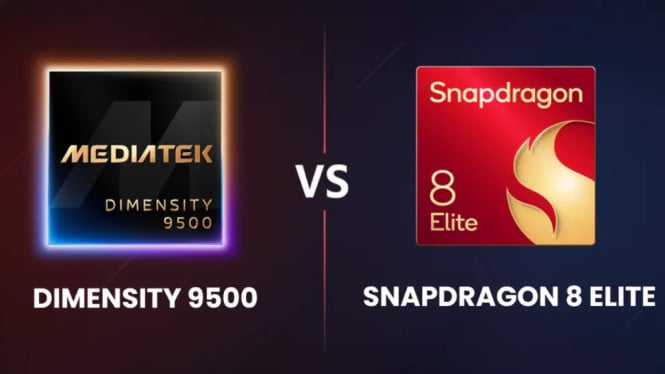
MediaTek has made a significant breakthrough in 2025 with its Dimensity 9500 chipset, finally challenging the dominance of Qualcomm’s Snapdragon 8 Elite. Recent benchmark results from devices like Vivo X300 Pro (Dimensity 9500) and Xiaomi 15 (Snapdragon 8 Elite) reveal a surprising shift in performance leadership. The Dimensity 9500 outperforms Snapdragon 8 Elite in key areas such as multi-core CPU speed, GPU strength, and power efficiency.
Both chipsets leverage TSMC’s advanced 3nm manufacturing process, but with distinct variations: Dimensity 9500 uses the N3P (3nm Performance-Enhanced) node, while Snapdragon 8 Elite relies on N3E (3nm Enhanced). The N3P technology offers 5–10% better power efficiency and slightly higher clock frequencies, providing MediaTek a critical edge during intensive workloads.
CPU Architecture and Performance
Dimensity 9500 adopts the latest ARM Cortex CPUs (C1 series) arranged in a 1+3+4 core setup, emphasizing balanced power efficiency and multi-core optimization. In contrast, Snapdragon 8 Elite uses Qualcomm’s custom second-generation Oryon cores in a 2+6 configuration, focusing on extreme single-core frequency up to 4.32 GHz.
Despite Snapdragon’s higher peak clock, the Dimensity 9500’s more structured core hierarchy enables better power management across varying tasks. Geekbench 6 benchmarks support this, showing Dimensity 9500 leading by 13% in single-core (3,452 vs 3,047) and 9% in multi-core scores (10,128 vs 9,286). This marks the first time since the Dimensity 9000 series that MediaTek has surpassed Qualcomm in CPU benchmarks.
GPU and Overall Benchmark Dominance
AnTuTu v11 results emphasize Dimensity 9500’s increased GPU and memory performance. The total score reaches 3,622,840 points, 22% ahead of Snapdragon 8 Elite’s 2,981,542 points. GPU scoring shows a strong 25% lead, thanks to the Mali-G1 Ultra MP12 GPU—the first 12-core ARM GPU—which delivers impressive graphics capabilities.
MediaTek’s support for UFS 4.1 memory further boosts responsiveness by over 50% compared to Snapdragon’s UFS 4.0, enhancing multitasking and heavy app handling. The inclusion of MediaTek HyperEngine gaming tech and smart thermal management (MRFC 3.0) allows Dimensity 9500 to sustain high frame rates like 120 FPS in demanding games such as Genshin Impact with ray tracing enabled.
Gaming Performance
In 3DMark Wild Life Extreme stress tests, Dimensity 9500 scores 49% higher in burst performance (7,163 vs 4,809) and 17% higher in sustained graphics output. Snapdragon 8 Elite’s Adreno 830 GPU remains strong but struggles to maintain peak performance during long gaming sessions compared to the Mali-G1 Ultra.
Camera and Multimedia Capabilities
Both chipsets handle camera sensors up to 320MP and offer 8K video recording. MediaTek’s Imagiq 1190 ISP emphasizes cinematic video features, including 4K/120fps recording with electronic image stabilization and AI-powered real-time semantic segmentation for bokeh effects.
Conversely, Snapdragon 8 Elite’s Spectra Triple 18-bit ISP excels in professional photography with features like zero shutter lag, multi-layer semantic segmentation, and advanced AI functions for auto-exposure, focus, and face detection. This makes Qualcomm’s chipset preferable for mobile photography enthusiasts requiring refined AI camera processing.
Connectivity: Trade-offs Between 5G and Wi-Fi
Snapdragon 8 Elite provides superior 5G connectivity, utilizing the Snapdragon X80 modem capable of up to 10 Gbps download speeds and 3.5 Gbps upload speeds compliant with 3GPP Release-17 standards. Meanwhile, Dimensity 9500 supports 7.4 Gbps for 5G but pioneers advanced Wi-Fi 7 with speeds up to 7.3 Gbps, outperforming the Snapdragon’s Wi-Fi 6E at 5.8 Gbps.
The connectivity split suggests Snapdragon suits users prioritizing fastest cellular data, while MediaTek favors those who depend on high-speed local wireless for gaming or media streaming.
AI Processing
The two chipsets integrate top-tier NPUs that support on-device AI. Dimensity 9500’s NPU 990 focuses on multimodal AI and extended contextual capabilities. Snapdragon 8 Elite incorporates Hexagon NPU with deep third-party ecosystem support, including Adobe, Google, and Microsoft applications. Qualcomm’s solution currently leads in mature AI application integration.
Final Observations
MediaTek’s Dimensity 9500 decisively narrows the gap with Snapdragon 8 Elite, outperforming it in multi-core CPU processing, GPU power, gaming performance, and power efficiency. Qualcomm preserves advantages in 5G connectivity and camera AI sophistication, maintaining appeal for users focused on network speed and mobile photography.
For gamers and multitaskers seeking excellent performance at potentially lower device costs, Dimensity 9500 presents a compelling option. For users demanding the fastest 5G and cutting-edge professional camera features, Snapdragon 8 Elite remains the leading choice.
Ultimately, the comparison shows that for the first time in five years, MediaTek offers a truly competitive flagship chipset that can outperform Qualcomm in critical areas. The choice between these powerful chipsets now depends primarily on individual priorities rather than clear-cut superiority.