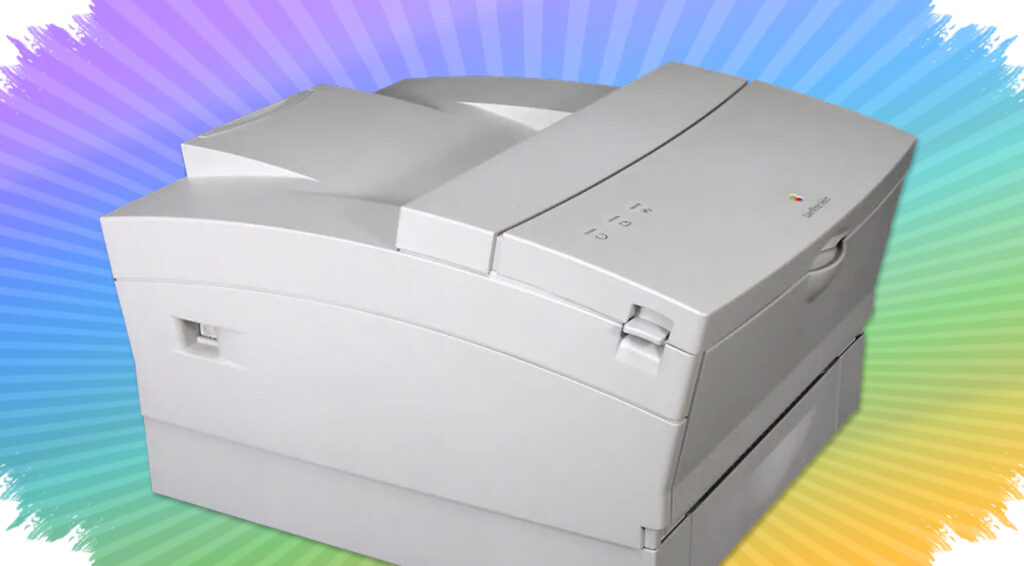
Apple is best known today for the iPhone, MacBook, and tightly integrated software ecosystems. Yet one of the company’s most important technology legacies came from a product many people no longer remember: the LaserWriter printer.
Released in March 1985, the LaserWriter helped turn desktop publishing from a niche professional workflow into something ordinary users could actually do. By working with the Macintosh, Adobe PostScript, and Aldus PageMaker, it changed how text and page layouts moved from a computer screen to a printed page.
Why the LaserWriter mattered
Before the LaserWriter arrived, Apple had the ImageWriter, a dot-matrix printer that handled basic printing needs. It was useful for everyday documents, but it could not deliver the sharp text and clean page layouts needed for serious publishing work.
The LaserWriter changed that by offering far better print quality and a more professional output. It helped make personal computers useful not only for writing but also for designing pages that looked close to the final printed result.
That shift was crucial because it made the WYSIWYG model, short for “What You See Is What You Get,” practical for a wider audience. What appeared on the screen could closely match what came out on paper, and that idea became a core standard in digital design and publishing.
The technology behind the printer
Apple equipped the LaserWriter with a Motorola 68000 chip, the same processor family used in the Macintosh. That choice helped the printer run Adobe PostScript efficiently, which was important because PostScript needed reliable processing to render complex page layouts.
The printer also delivered 300 dpi resolution and could print eight pages per minute, according to the reference material. At the time, those specifications placed it in a premium category, especially with a launch price of about $7,000, or roughly $113 million in Indonesian rupiah at the time.
- Released in March 1985
- Built for the Macintosh and Adobe PostScript ecosystem
- Compatible with Aldus PageMaker for desktop publishing
- Used a Motorola 68000 processor
- Printed at 300 dpi
- Produced up to eight pages per minute
Those numbers may look modest by current standards, but they were highly competitive in the mid-1980s. More importantly, the LaserWriter was not designed only as a printer hardware product, but as part of a larger digital publishing system.
How it shaped desktop publishing
The LaserWriter helped move publishing work from large printing facilities to personal computers on office desks. That change made it easier for users to create brochures, newsletters, business documents, and magazine layouts without relying entirely on outside production services.
Adobe PostScript benefited strongly from this adoption. As a page description language, it gave printers precise instructions on how to render text and graphics, and LaserWriter became one of the devices that proved the concept could work at scale.
That influence spread beyond Apple’s own ecosystem. As more manufacturers adopted similar approaches, PostScript became one of the important standards in modern printing, especially for professional publishing and graphics workflows.
Why the standard still matters today
Modern printers are far more capable than the LaserWriter ever was. Many laser printers now reach 1,200 dpi and can print around 35 pages per minute, while even affordable inkjet models offer better speed and sharper output than early printers.
Still, the LaserWriter’s real legacy is not measured only by print speed or resolution. Its importance lies in the workflow it helped establish, where personal computers became the center of document creation and production.
That workflow remains visible in today’s design software, office printing, and digital publishing systems. The WYSIWYG principle, PostScript’s influence, and the expectation that on-screen layouts should translate accurately to print all trace back to the era when Apple’s LaserWriter helped define what modern printing could become.
The LaserWriter shows that a product does not need a long commercial life to leave a lasting mark. In Apple’s case, a forgotten printer helped set standards that still shape how documents are designed, rendered, and printed today.