Samsung is signaling that its next wearable push will be built around AI, not just around familiar categories like watches and standard earbuds. The company has now confirmed plans to expand its wearable lineup with AI glasses and a broader Galaxy Buds range, pointing to a strategy that is becoming more ambitious and more closely tied to everyday use.
That direction matters because Samsung is no longer treating wearables as simple accessories. After moving into Android XR headsets, the company appears ready to pursue lighter devices that rely more heavily on multimodal AI and are easier to wear throughout the day.
AI glasses move to the center
During its first-quarter 2026 performance briefing, Samsung made its clearest statement yet about where its wearable roadmap is headed. Seong Cho, Executive Vice President of Samsung Mobile eXperience, said the company plans to deliver immersive multimodal AI experiences across different form factors, including AI glasses.
That comment fits with earlier signs that Samsung was preparing something in this category. The company is now shaping wearables around voice, camera input, and visual context, rather than limiting them to basic notification handling or audio playback.
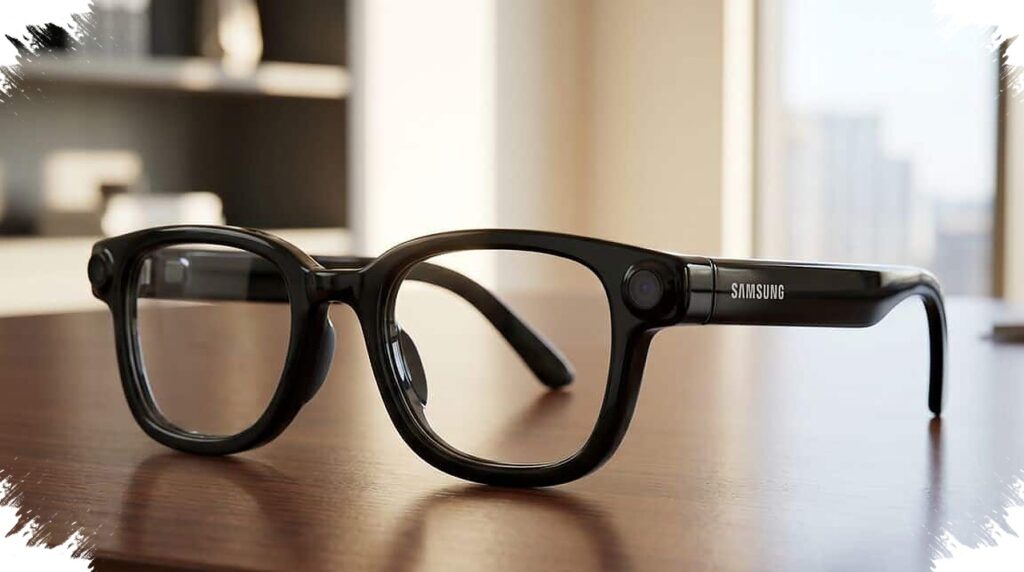
Reports circulating around the product suggest the first Samsung smart glasses may arrive under the Galaxy Glasses name. They are expected to run Google’s Android XR platform, placing them directly in the company’s extended reality path.
If those details hold, the glasses would include a speaker, microphone, and a 12MP camera. That combination would support voice commands, visual capture, and audio output directly from the frame.
Gemini is also said to be positioned as a key engine for the device. Its tasks could include answering questions, taking photos or videos, sharing content to social media, and playing music.
A lighter wearable experience
Samsung’s move toward AI glasses suggests a broader shift in how it wants wearables to fit into daily life. Instead of focusing only on wrist-worn devices or conventional earbuds, the company appears to be building products that feel more natural in routine use and depend more on contextual AI.
The company has already introduced its first Android XR-based headset, so the next step looks aimed at a more practical form factor. AI glasses would give Samsung another way to connect multimodal AI with everyday actions while keeping the hardware less intrusive than a headset.
That would also place Samsung in direct competition with Meta’s AI glasses. The contest is expected to extend beyond hardware design and into AI assistant quality, ease of use, and the strength of each company’s app ecosystem.
Galaxy Buds are also expanding
Samsung is not limiting its wearable plans to glasses. The company also confirmed that the Galaxy Buds family will expand, showing that it wants more than one wearable category to carry its next phase of growth.
One product reportedly in development is a new true wireless earbud model called Galaxy Buds Able. It is said to feature a clip-on design and bone conduction technology, which would mark a clear departure from the usual in-ear approach.
A clip-on format would signal a focus on a different wearing experience, while bone conduction points to an audio method that does not rely entirely on the conventional earbud structure. Even with limited details, the reported direction suggests Samsung is exploring more varied ways to deliver wearable audio.
If Galaxy Buds Able does arrive, it would add another layer to a lineup that has long been associated with standard wireless earbuds. Together with AI glasses, it would show Samsung moving toward a more diversified wearable portfolio across different use cases.
Business pressure adds urgency
The timing of this expansion also fits a broader business challenge for Samsung. The company has warned that ongoing memory chip supply constraints could worsen in 2027, with possible effects such as higher smartphone prices and weaker sales.
Samsung said it plans to offset that pressure by increasing sales of higher-end smartphones. At the same time, shipments of laptops and tablets are also expected to decline.
That backdrop helps explain why wearables and AI-driven devices are becoming more important in Samsung’s product strategy. In a market facing supply strain and softness in other device categories, new wearable form factors may offer another path for growth.
For now, Samsung has not announced an official launch schedule for either product. Still, the direction is clear: the next wave of wearables will lean on AI, new form factors, and deeper integration with Android XR and Gemini.