
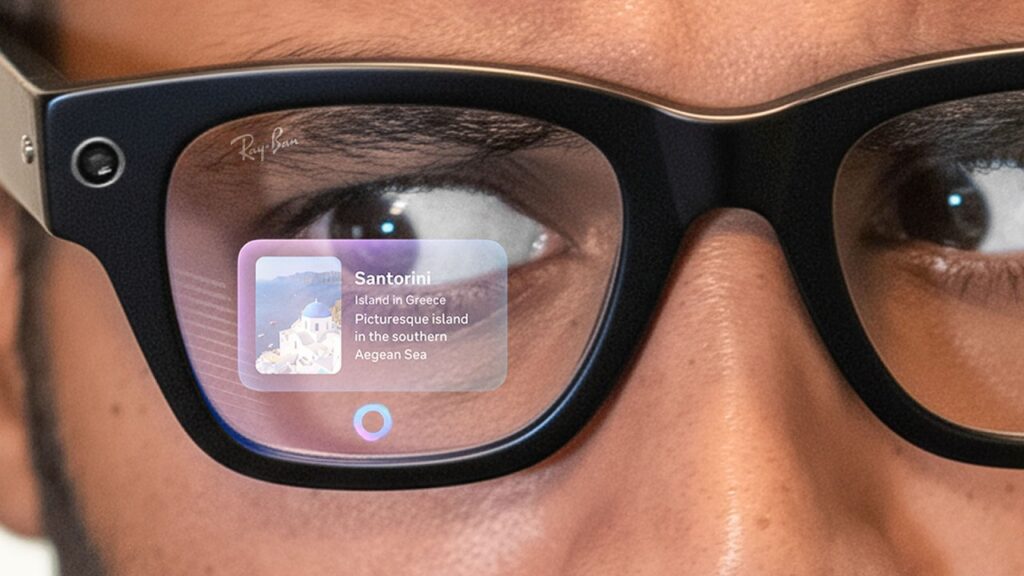
Meta is pushing Ray-Ban Display closer to being a practical everyday device, not just a smart pair of glasses for quick alerts. The latest update adds a new way to type in midair, expands navigation, and opens the platform to third-party developers.
The most notable addition is Neural Handwriting, which is now available to all users after starting as a limited beta in Messenger and WhatsApp. It lets people write letters with finger movements in the air or on almost any surface, then use that input to search contacts, send messages, and reply to phone notifications.
Neural Handwriting works on both iOS and Android and supports apps including Instagram, WhatsApp, Messenger, and message notifications from the phone. To use it, wearers need the Neural Band bundled with the $800 Ray-Ban Display package.
Meta uses sEMG technology in the band to detect muscle movement. That allows the system to recognize when a user is effectively “writing” letters on a desk, a palm, or even a thigh.
That input method gives Ray-Ban Display a more direct control scheme than many other smart glasses, which still rely mainly on voice, touch, or camera-based interaction. On this device, hand-based input is becoming one of the main ways to operate the glasses without reaching for a phone.
The update also adds display recording, which can capture what is shown on the screen, the camera’s point of view, and ambient audio in a single video file. That moves the device further toward a lightweight computing tool that records context, not just notifications.
Navigation has also been expanded. Search results are now richer, while walking directions cover the entire United States and major international cities such as London, Paris, and Rome.
The navigation system also supports saved home and work locations. Voice navigation is included as well, making it easier to use the glasses while moving without depending too much on the display.
Communication features have been improved too. WhatsApp now supports group video calls and phone call captions, while Instagram gains better Reels and DM navigation. Facebook also gets widgets for birthdays and sports.
A more open platform for developers
One of the biggest changes comes from the software side. Meta is officially opening Ray-Ban Display to third-party developers, which could extend the glasses well beyond the built-in apps.
The company is offering the Device Access Toolkit SDK for iOS and Android. Developers can use it to add guided interfaces to existing native mobile apps or build new apps specifically for Ray-Ban Display.
WebApps are also supported. Meta says well-built web apps can appear and behave properly on the glasses, which matters for a wearable platform that needs more software options to fit everyday use.
Early experiments already hint at what that openness could mean. The community has found ways to run YouTube video on the glasses, and other early use cases have started to appear.
Those use cases include flight assistance tools, shopping lists, transit navigation, and games. With third-party access now in place, Meta appears to be positioning Ray-Ban Display as a platform rather than only a piece of hardware.
Meta’s flagship smart glasses get a clearer role
Ray-Ban Display sits at the top of Meta’s smart glasses lineup. It differs from other Ray-Ban Meta models, which focus on the camera and do not include a screen overlay.
This update makes the product direction more obvious. Meta wants the glasses to do more than see and record; it wants them to accept input, show interfaces, and support more app-driven scenarios.
Neural Handwriting is the clearest sign of that shift. When users can type with finger movements on nearly any surface, the friction of quick communication on smart glasses drops significantly.
Along with the display recording feature, the richer map tools, and the third-party developer access, the update adds important foundations for daily use. Ray-Ban Display is now being shaped as a more complete wearable for messaging, navigation, and new app experiences.