


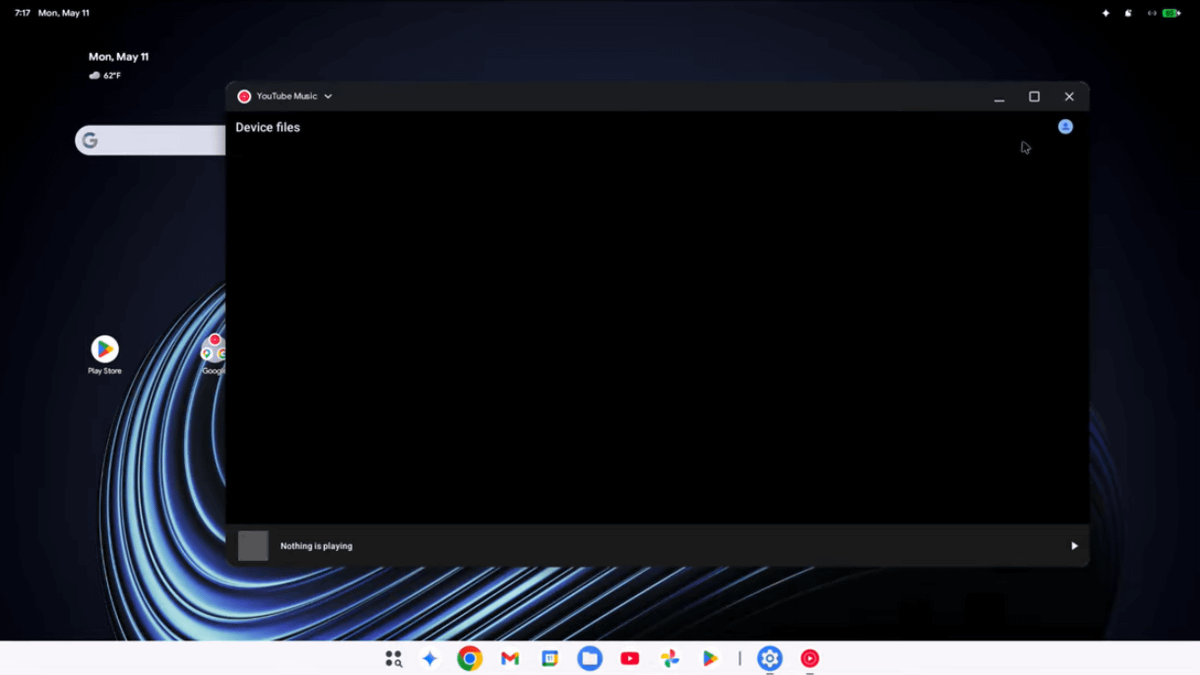
The leaked Aluminium OS build is already shaping the early debate around Google’s next laptop platform, but not because it looks finished. Instead, the footage suggests a system that is still trying to prove whether it is a true desktop rethink or simply Android stretched further for larger screens.
Mystic Leaks shared a 16-minute hands-on video on Telegram, along with screenshots showing the home screen, Settings, Quick Settings, and an app called Link to iOS. Those early visuals point to a strong Android foundation, while also showing that Google is experimenting with desktop-style presentation.
A laptop system built on familiar Android foundations
The setup process shown in the leak looks much closer to standard Android than to a brand-new desktop operating system. Once past the wizard, the interface presents a dock at the bottom, a Google search bar, a Play Store icon, and a folder of Google apps.
The Settings app also gives away the direction of the build. It reportedly identifies the system as based on Android 17, which suggests adaptation rather than a complete break from Android.
That detail matters because Google has not confirmed the official operating system name for Googlebook. Aluminium OS may still be only an internal codename, not the final brand that reaches users.
Desktop touches are there, but the system still feels early
Even with its Android roots, the leaked build clearly tries to behave more like a laptop environment. The status bar resembles macOS, and virtual desktop support appears integrated with the Recents screen for managing multiple workspaces.
Quick Settings also moves in a more desktop-like direction. Instead of dropping from the top of the screen as on many Android phones and tablets, the panel appears from the upper-right corner.
Those changes help the interface look more suitable for a notebook, but they do not hide the fact that the build is still in early development. The leaked version was running on a MacBook Pro through the UTM emulator, so it should not be treated as the final software experience.
More DeX than a full desktop platform, for now
The most telling limitation in the leak is how unfinished the app environment still appears. Mystic Leaks says the current version feels more like a polished version of Samsung DeX than a mature desktop operating system.
A number of Google apps appear to run as wrapped web versions inside windows, which suggests that native large-screen app optimization is still limited. The leak also points to a lack of apps that are truly tuned for mouse and keyboard use.
That makes Aluminium OS look like a work in progress rather than a complete productivity platform. The basic desktop frame is visible, but the surrounding app ecosystem has not caught up yet.
Why the Link to iOS app stands out
One of the more unusual details in the leak is the presence of Link to iOS. Its inclusion suggests Google may want Googlebook to work in mixed-device households, not just Android-only setups.
That approach could help the new laptop line appeal to premium buyers who do not live entirely inside one ecosystem. If iPhone compatibility is solid, Googlebook could become a more flexible option in the broader laptop market.
Google introduced Googlebook in The Android Show: I/O Edition 2026 only a day before the leak surfaced. The line is being positioned as a premium laptop family built around Gemini Intelligence, with Acer, ASUS, Dell, HP, and Lenovo expected to bring devices to market starting in the fall.
Google has also highlighted Magic Pointer as one of Googlebook’s key features. The Gemini-powered cursor is designed to surface contextual actions as it moves across the screen, adding another layer to the company’s desktop ambitions.
For now, the leaked Aluminium OS build offers only an early look at what may power that transition. Google is expected to provide more detail at Google I/O 2026, which begins on May 19, but until then the software remains firmly in leak territory.