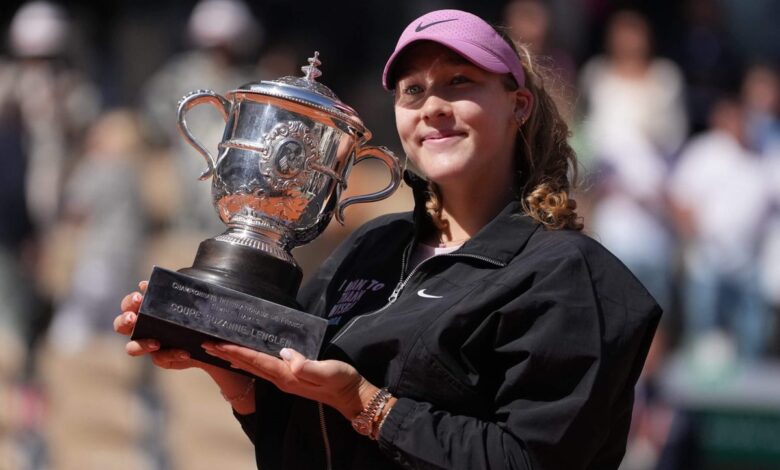
Mirra Andreeva’s first Grand Slam title always felt like a matter of when, not if. At Roland Garros, she turned that expectation into reality by beating Maja Chwalińska 6-3, 6-2 and claiming her maiden major in commanding fashion.
The win confirmed what has seemed true since Andreeva burst onto the scene as a 15-year-old at the Madrid Open. She was talented enough to challenge established names early, and now she has added a Grand Slam trophy to a career that has already moved quickly toward the top of the sport.
A champion shaped by pressure and patience
Andreeva’s path to this moment has not been smooth. Her rise has included visible frustration, emotional matches, and several losses that exposed how difficult it can be to carry expectation on the women’s tour.
She had already shown how high her ceiling could be in Madrid, where she impressed immediately as a teenager and beat a Grand Slam finalist and two top-20 players on the way to the fourth round. But the road to a major title also included setbacks, including a defeat at Indian Wells after the pressure of being the favorite affected her game.
At Roland Garros, that experience mattered. Andreeva entered the tournament among the most likely contenders, but she still had to prove she could handle the final stages as the player everyone else was chasing.
How she won in Paris
The final itself was shaped by a contrast in styles. Chwalińska, the world No. 114 at the start of qualifying, had surprised many players with her left-handed spins, height, and drop shots, and she had been one of the breakout stories of the tournament.
Andreeva adjusted better under the windy conditions and the unusual rhythm Chwalińska created. She lost serve twice early, then steadied herself and pulled level at 3-3 before taking control as her opponent’s errors began to rise.
Once Andreeva found her range, the match shifted quickly. She moved ahead in the second set, used a mix of touch, power, moonballs, and drop shots to blunt Chwalińska’s game, and stayed calm when serving for the title despite a brief wobble at 6-3, 5-1.
On her first match point, she finished the point with a short crosscourt backhand into the corner and dropped to her knees in celebration. It was a fitting finish for a player whose control of the moment has often been the missing piece.
Why this title changes the picture
The French Open draw also helped show how open the women’s game can be. Several of the top names fell early, including Elena Rybakina, Coco Gauff, Iga Świątek, and Aryna Sabalenka, leaving Andreeva as the only top-10 player left in the semifinals.
That made the final stretch less about surviving a gauntlet of proven champions and more about handling the weight of being the favorite. Andreeva did that well, first by beating Marta Kostyuk in the semifinals and then by taking care of business in the final.
Her victory also places her in a new group of champions. She became the first teenager to win a Grand Slam title since Gauff at the 2023 U.S. Open, and her name now sits alongside the sport’s most dangerous contenders near the top of the rankings.
The mental shift behind the breakthrough
The title also reflected work beyond shot-making. Andreeva had been reminded by her psychologist that she could decide what kind of player she wanted to be on court, and she said after the final that she had chosen to be “a fighter.”
That mindset helped her reset after earlier disappointments, including a difficult loss in Madrid where she doubted herself openly during the match. Instead of folding under that pressure, she used it as a turning point and began studying Roger Federer’s composure to better understand how to stay calm under stress.
In Paris, that preparation showed. Andreeva’s talent was never in doubt, but her ability to manage nerves and recover from mistakes finally matched it on the biggest stage.
Read more at: www.nytimes.com