A yellow card at the World Cup was wiped away for the first time under a new mistaken-identity law, turning a routine foul review into a much bigger test of how far VAR can go.
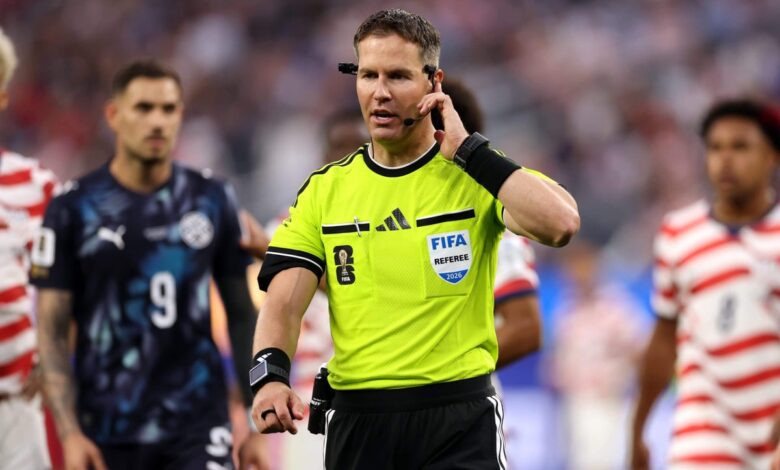
Tim Ream initially went into the book after referee Danny Makkelie believed he had tripped Paraguay forward Miguel Almiron, only for video assistant referee Carlos del Cerro Grande to intervene and send the official to the monitor.
Once Makkelie reviewed the footage, he saw that Ream had not made contact with Almiron. The caution was removed, and the Paraguay player was booked for simulation instead.
How the World Cup law changed
The tournament in the United States, Canada and Mexico has introduced a set of new VAR powers, including the ability to step in when the wrong player has been cautioned or sent off.
Under IFAB’s updated wording, VAR may assist in cases of a “clear and obvious error” or “serious missed incident” linked to mistaken identity, when the wrong player has received a yellow or red card.
| Situation | What VAR can do |
|---|---|
| Wrong player shown a card | VAR can intervene for mistaken identity |
| Clearly incorrect second yellow | VAR may intervene |
| Incorrectly awarded corner kick | VAR may intervene |
| Goal kick that should have been a corner | VAR cannot reverse it |
Previously, IFAB’s laws only allowed review when the referee cautioned or sent off the wrong player on the offending team. Ahead of the World Cup, that was widened so the offence itself cannot be reviewed except in the context of mistaken identity.
Why the decision matters beyond one card
Former Premier League referee Graham Scott said the episode set “three clear precedents” that are unlikely to be reversed and could lead to even more VAR involvement.
He pointed out that play had already restarted before the review, which had previously been a hard stop on intervention except in violent conduct and spitting cases.
Scott also noted that the definition of mistaken identity has been reinterpreted, and that VAR has now been given licence to check a player’s first yellow card, not just a second caution.
According to his analysis for www.nytimes.com, that opens the door to all yellow cards being checked and potentially reviewed by the referee.
The process was not quick, either. Makkelie eventually reached the correct outcome, but the sequence took more than three minutes and created confusion inside the stadium and on the pitch.
It also raised questions about consistency, because a similar incident in the World Cup opener between Mexico and South Africa did not bring a VAR intervention, even though Mexico’s Brian Gutierrez was booked after a clear dive by Teboho Mokoena.
For all the correction in the Paraguay match, the bigger concern is how much the system now reaches into incidents that used to be left alone.
The United States still went on to a strong start in the game, racing into a 3-0 lead at SoFi Stadium behind two goals from Folarin Balogun and an own goal, but the referee’s review is likely to remain one of the tournament’s most significant early talking points.