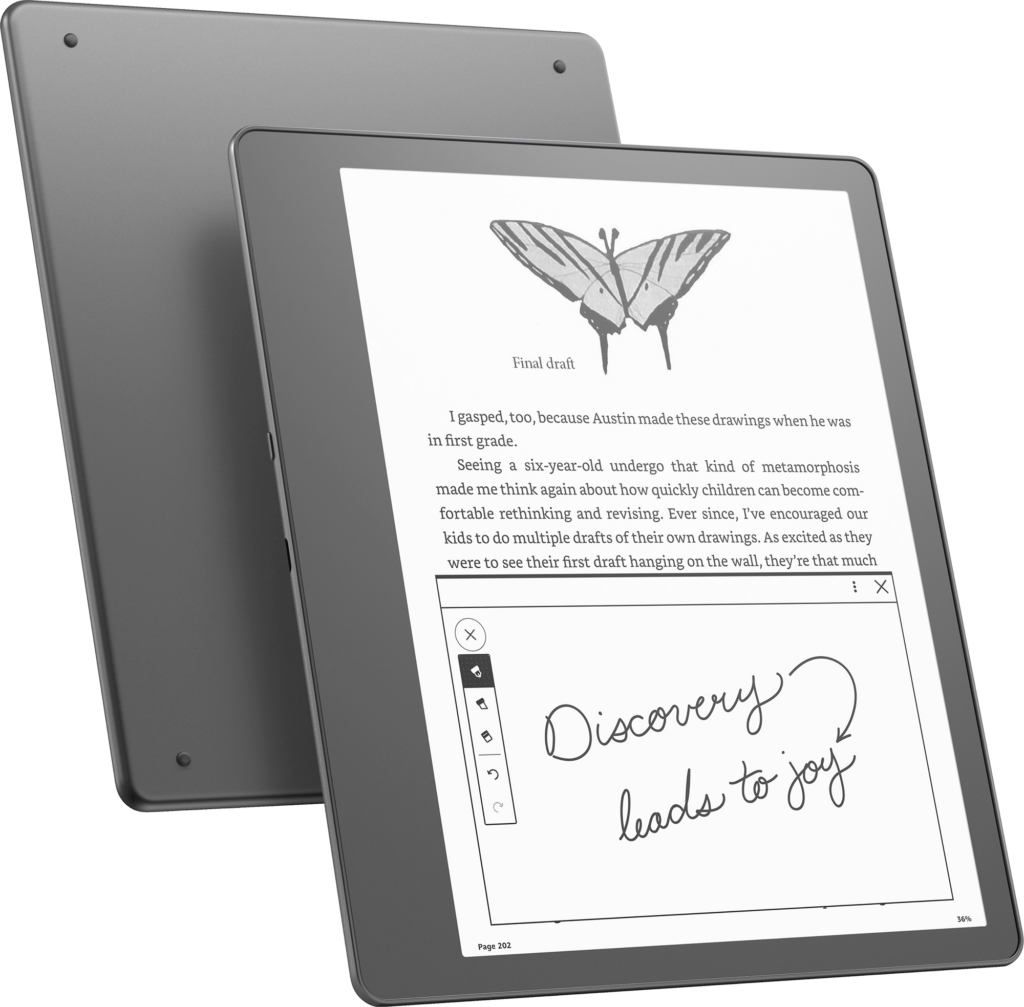
Amazon’s newest Kindle Scribe makes a deliberate tradeoff that is rare in today’s e-reader market: it removes the front light entirely. That choice pushes the device closer to the feel of paper, but it also makes the reading and writing experience more dependent on external lighting.
The result is a product with a narrower purpose. It is aimed at people who want a focused digital notebook and reading device, not a general-purpose e-reader that must stay comfortable in every lighting condition.
A thinner display stack is the key change
Amazon’s decision is tied to the Kindle Scribe’s slimmer display structure. By reducing the thickness of the screen layers, the company has brought the stylus tip and the digital ink output closer together in visual terms.
That smaller gap reduces parallax, the slight mismatch between where the pen appears to touch and where the mark shows up. In practice, the writing experience feels more precise and more natural for note-taking, journaling, and sketching.
Amazon also added a textured surface to better mimic the feel of traditional paper. Together with the thinner screen stack, that surface treatment is central to the device’s new writing approach.
A clearer compromise for bright spaces
Without a front light, the Kindle Scribe is less flexible in dim environments. Users who read or write in darker rooms will need an external light source, which is a clear departure from the standard approach used by many modern e-readers.
That compromise appears intentional. Amazon seems to be prioritizing the feel of pen on paper over all-day versatility, and the device therefore fits best in well-lit spaces.
Modern features remain in place
The stripped-back lighting design does not mean the device is barebones. Amazon has still equipped the new Kindle Scribe with a quad-core processor to support smooth navigation and document editing.
It also includes AI-based tools, among them natural-language search. For reading, Amazon has added a “story so far” feature that provides a short recap of a book’s content so users can pick up the thread more easily.
Storage stays limited by design
Storage is another area where the device reflects its focused identity. The Kindle Scribe comes with 16GB of memory, but only about 10GB is available for user content.
That should be sufficient for text-based files, but it may feel tight for people who plan to store many PDFs, images, or larger documents. The capacity matches a product built around simplicity rather than acting as a large digital library.
Premium pricing and a specific audience
Amazon plans to launch the new Kindle Scribe on June 10, 2026, with a price of $429. That places it firmly in the premium category and makes its target audience fairly clear.
The device is for users who value an authentic digital writing experience and are willing to accept the limits that come with it. For readers and note-takers who usually work in bright environments, the design may feel appealing because it leans so heavily into the paper-like concept.
There may also be an efficiency benefit from removing the front light, since fewer LEDs should reduce power demand. Amazon has not disclosed any official battery-life figures, but the design could help the device last longer between charges.
Source: www.geeky-gadgets.com