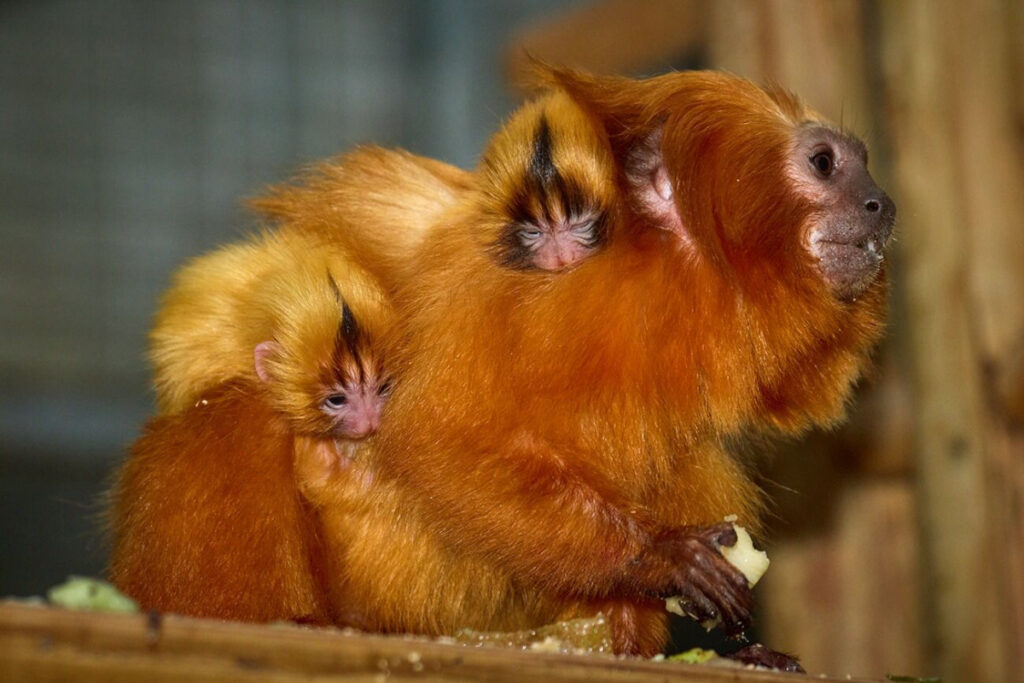
What was once a near-collapse has become one of the clearest examples of wildlife recovery in the Atlantic Forest of Brazil. The golden lion tamarin, a small primate with a striking golden coat, now has a wild population that has climbed to more than 4,800 animals.
That figure marks a dramatic turnaround for a species that once hovered on the edge of disappearance. It also shows how long-term protection, when sustained across many years, can still reverse a decline that once seemed irreversible.
A species pushed to the brink
Golden lion tamarins are native to Brazil’s Atlantic Forest and measure about 20 to 33 centimeters in body length. Their golden fur gives them a mane-like appearance, which makes them one of the most recognizable primates in the region.
The species suffered a severe population crash in the 1960s and 1970s as human settlement expanded, farmland spread, and forests were cut down. At that time, only around 100 to 600 individuals were believed to remain in the wild.
That collapse raised urgent concern among researchers and conservation groups. As the forest shrank, the outlook for the species became increasingly fragile.
Recovery built over decades
The rebound did not happen through a single intervention. Conservation work included captive breeding, reintroduction into natural habitat, the creation of forest corridors, and restoration of damaged areas.
Protection efforts also relied on more than conservation institutions alone. Government agencies and local communities became part of the effort to keep the species’ habitat secure.
Those combined actions helped push the wild population above 4,800 individuals, according to the latest conservation figures. For a species once reduced to only a few hundred in the wild, the increase represents a major shift.
A recovery that still faces risks
Even with that progress, the species remains vulnerable. In 2016, a yellow fever outbreak affected parts of its habitat and caused another population drop.
The number of animals had been around 3,700 before the outbreak, but it later fell to about 2,500. The event showed that recovery does not eliminate risk, especially when disease can spread through already pressured ecosystems.
After that decline, researchers added stronger monitoring of the animals’ health and developed strategies to guard against similar threats. That step is important for preventing another sudden loss after years of rebuilding.
Why the case matters
The golden lion tamarin is now widely seen as a proof point for conservation that lasts. Its recovery reflects a mix of habitat protection, public involvement, and scientific monitoring rather than a quick fix.
Organizations such as the Smithsonian National Zoo & Conservation Biology Institute, the Conservation Planning Specialist Group (CPSG), the International Union for Conservation of Nature (IUCN) Red List, and the Golden Lion Tamarin Association are part of the documented conservation record behind this progress.
In a period when many species remain under threat, the golden lion tamarin stands out as a reminder that sustained action can bring a species back from the edge of extinction.
Source: mediaindonesia.com