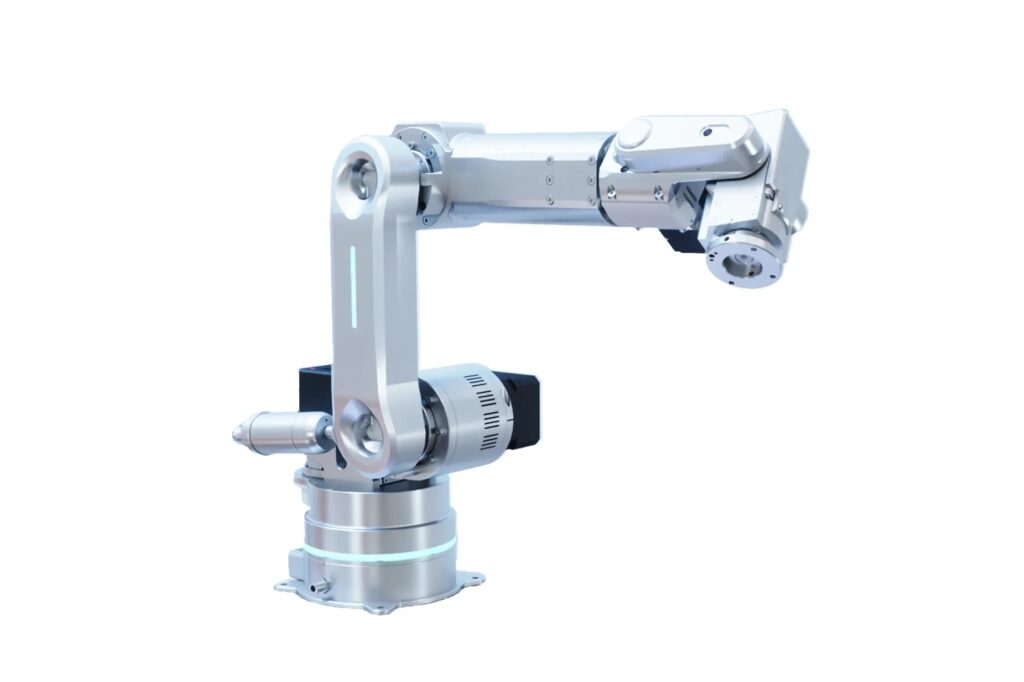
A compact robot arm is usually expected to trade capability for size. WLKATA Haro380 takes the opposite approach, packing a 6-axis design, high precision, and broad integration options into a form built for tight spaces.
That combination is what makes the robot stand out in mini industrial robotics. With repeatability of ±0.05 mm and a reach of 434 mm, Haro380 is positioned for detailed work that needs consistent output rather than simple demonstration tasks.
Built for small spaces without losing function
When folded, Haro380 measures about 38 x 25 x 22 cm, which makes it easier to place on a workbench, in a small research cell, or on a production line with limited room. Its compact footprint is one of the main reasons it attracts attention beyond education settings.
The robot also supports a 500 g payload and can be extended to 1000 g under certain conditions. That gives it enough flexibility for practical use cases while keeping the platform relatively small.
Mounting options add another layer of adaptability. Haro380 can be installed vertically, overhead, or on the side, which helps it fit work environments that do not follow a standard layout.
Tool changes happen in seconds
One of the most notable features is its magnetic docking system for automatic end-effector switching. This setup lets the robot move from one task to another quickly, without lengthy manual reconfiguration.
WLKATA offers several end-effector options, including soft and hard grippers, a pneumatic sucker, and specialized tools for laser engraving and dispensing. With that range, one robot can cover multiple workflows in the same setup.
That flexibility expands the list of possible applications. Haro380 is aimed at pick-and-place, material handling, assembly, dispensing, and micro-manufacturing, while also being suitable for creative and technical workflows such as laser engraving and 3D printing operations.
Designed to fit different users and systems
Control support is broad enough to serve both beginners and experienced developers. Haro380 is compatible with Python, C++, and Blockly, which makes it usable in education, prototyping, and development environments.
At the system level, the robot also supports ROS2, MATLAB, PLC automation, and EtherCAT. Those compatibility layers help it connect with research setups and existing industrial automation environments.
Connectivity options include USB, RS485, Wi‑Fi, Bluetooth, and Modbus. The open API and the range of protocols give users more room to integrate the robot into different scenarios, from laboratory experiments to light production lines.
For more direct operation, Haro380 also supports real-time control, manual teaching, and gesture or voice commands. These features reduce the barrier to entry in training environments and prototype development workflows.
Software support extends the platform
The hardware is only part of the package. WLKATA also provides a software ecosystem built to speed up programming, simulation, and testing.
WLKATA Lab and WLKATA Studio serve as the native software tools for operation and programming. Compatibility with RoboDK and digital twin platforms gives users a way to simulate workflows before deploying the robot in practice.
That matters in mini industrial robotics, where rapid iteration is often important. Simulation can reduce risk to physical hardware while helping users test changes more efficiently.
Mobile app support is also available for control and remote monitoring. This adds convenience in training spaces, laboratories, and workstations that need quick access to the robot.
Beyond education into serious applications
Haro380 is positioned for robotics education, but its intended use goes much further. It is also targeted at machine vision integration, AI framework development, and advanced research that needs a compact but serious robotic platform.
On the industrial side, the focus includes material processing, assembly, and precision dispensing. That makes the robot relevant not only as a learning tool, but also as a working machine for light manufacturing tasks.
Durability and safety are also part of the design. Haro380 uses harmonic drive joints to support precision and rigidity, along with a CNC-machined aluminum alloy frame that is meant to stay light yet strong.
Protection features include overload, overheat, and electrostatic safeguards. Those systems help maintain stable performance while improving safety for both users and equipment.
WLKATA lists the Haro380 Advanced Kit at $5,690 USD. The package includes a more complete end-effector set and educational accessories, with financing options available to widen access for users.
In a market where compact automation is becoming more flexible and more programmable, Haro380 shows how a small robot arm can move past the role of a simple demo unit. Its precision, fast tool switching, software support, and installation flexibility give it a stronger position in the mini industrial robotics category.
Source: www.geeky-gadgets.com