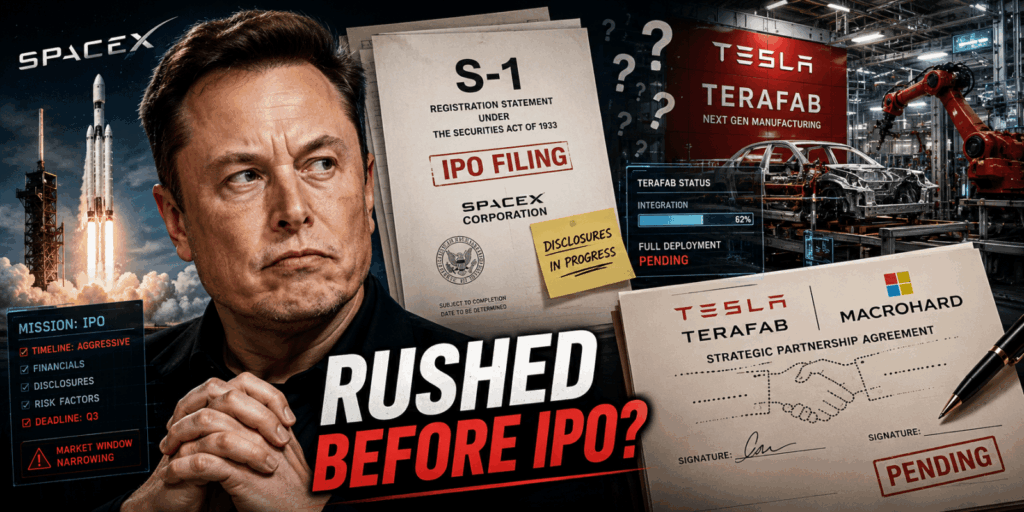
For more than two decades, SpaceX has operated with unusual secrecy for a company that reshaped the launch market. That changes with its IPO filing, which reveals a business far larger and more complex than rockets alone, while still leaving Elon Musk firmly in control.
The listing is drawing outsized attention because the company is valued at about $1.25 trillion. If the stock performs strongly after its U.S. market debut, Musk could become the first person to reach a net worth of $1 trillion.
Control remains concentrated
What stands out most is not only the scale of the offering, but the structure around it. According to the filing, Musk is set to remain CEO, CTO, and chairman of the board, while the company is arranged to limit the power of public shareholders.
That means investors may be able to buy into SpaceX, but the company’s direction is still expected to stay largely in Musk’s hands. The filing also indicates that legal disputes would mostly go to arbitration, while investor lawsuits would face restrictions on where they can be filed.
SpaceX has long been seen as a company that keeps launch costs under pressure through reusable rocket technology. That approach has already altered the economics of spaceflight and pushed rivals such as Jeff Bezos’ Blue Origin to move faster.
A broader business than rockets
The IPO paperwork gives the market a clearer look at how much SpaceX has expanded beyond its original identity. The company now operates Starlink, works on reusable rockets, and owns xAI, Musk’s artificial intelligence company.
That wider scope shows how SpaceX has moved from being a launch company into a platform that spans satellite internet, AI infrastructure, and future space ambitions. Reuters previously reported that the IPO roadshow was targeted to begin on 4 June.
Share sales could start as early as 11 June, ahead of a planned listing on 12 June under the ticker “SPCX”. For investors, the offering is also a major test of whether a company can grow to massive scale while remaining largely insulated from the pressure of public markets.
Financial strain sits alongside growth
The filing also reveals that SpaceX is spending heavily to push into artificial intelligence. The company is moving beyond its old image as a rocket builder and toward a larger technology infrastructure business.
That expansion comes with clear financial pressure. In the first quarter of this year, SpaceX posted revenue of $4.69 billion but still reported an operating loss of $1.94 billion.
The AI unit was the biggest drag on results. It recorded a loss of $2.47 billion on revenue of just $818 million, while Starlink was the only major business to generate an operating profit during the period, at $1.19 billion.
Ambition, assets, and legal risk
SpaceX’s balance sheet shows the scale of what it is trying to build. The company has about $102 billion in assets, including rockets, satellites, and other infrastructure, but it also carries roughly $60.5 billion in debt.
The filing further warns investors that legal costs could exceed half a billion dollars because of ongoing lawsuits and claims. Some of that legal pressure is linked to Grok, the chatbot developed by xAI.
Those claims allege that the chatbot was used to create sexual deepfakes involving real women and girls. At the same time, the filing discloses a major partnership with Anthropic, the company behind the Claude chatbot.
Under that arrangement, Anthropic is said to pay $15 billion per year for access to data centers in the southern United States that support Musk’s AI operations. The deal underscores how central computing infrastructure has become to the competition around AI.
SpaceX is now presenting itself as much more than a launch provider. Its filings suggest a company betting on a future that combines space transport, global connectivity, artificial intelligence, and even Mars, while asking public investors to back that vision without gaining meaningful control over it.
Source: www.indiatoday.in