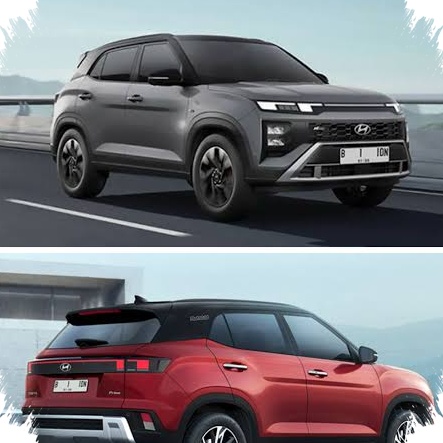
Hyundai Creta continues to stand out not only because it remains visible in the new-car market, but also because it still draws interest on the used-car side. That double appeal gives the compact SUV a rare kind of stability, especially for buyers who care about design, equipment, and resale value at the same time.
The model’s position has been reinforced by its local production at PT Hyundai Motor Manufacturing Indonesia (HMMI). That status helps Creta stay relevant in a crowded segment, while the name itself continues to carry weight among buyers looking for a compact SUV with a recognizable identity.
A design that still separates it from the crowd
Creta keeps relying on Hyundai’s Sensuous Sportiness design language to create a bold and charismatic look. At the front, the Parametric Jewel Grille works with the Parametric Jewel Hidden Type DRL, which leaves the main lamps hidden when the engine is off.
The rear styling also helps the SUV remain easy to identify. The High Mount Stop Light and Boomerang-type Rear Combination Lights give the back end a distinct signature, while the N Line and N Line Turbo versions push the sporty theme further with more aggressive body kits, dual exhausts, matte touches, and special alloy wheels.
Powertrain choices that fit everyday use
Most Hyundai Creta variants use a 1,500 cc Smartstream four-cylinder gasoline engine. It produces 115 PS at 6,300 rpm and peak torque of 143.8 Nm, with power sent to the front wheels through either a 6-speed manual transmission or an Intelligent Variable Transmission (IVT).
For drivers who want a sharper response, the N Line Turbo variant brings a more immediate and aggressive character. That gives Creta a wider spread of personalities, from practical daily transport to a more spirited driving feel.
Cabin equipment and safety features
Inside the cabin, Creta offers features that keep it competitive in daily use. The list includes a large Panoramic Sunroof and a BOSE Premium Audio System, while higher trims add Ventilated Seat, Wireless Smartphone Charger, and Hyundai Bluelink smartphone connectivity.
Safety remains one of the SUV’s stronger selling points as well. Hyundai equips Creta with Forward Collision-Avoidance Assist (FCA), Lane Keeping & Lane Following Assist (LKA & LFA), Blind-Spot Collision-Avoidance Assist (BCA), and Rear Cross-Traffic Avoidance Assist (RCCA).
These systems matter because they make the model more than just a styling-focused product. They also strengthen its role as a compact SUV for urban driving, where active safety support can make a real difference.
2026 OTR Jakarta prices for Hyundai Creta
Hyundai’s On The Road Jakarta pricing for Creta in 2026 covers a fairly broad range. That spread gives buyers room to choose between efficiency, equipment, and a sportier image without moving to a larger vehicle class.
| Variant | Price |
|---|---|
| Hyundai Creta Active MT | Rp299,700,000 |
| Hyundai Creta Trend MT | Rp331,640,000 |
| Hyundai Creta Trend IVT | Rp352,140,000 |
| Hyundai Creta Style IVT | Rp396,640,000 |
| Hyundai Creta Prime IVT | Rp426,940,000 |
| Hyundai Creta N Line IVT | Rp460,500,000 |
| Hyundai Creta N Line Turbo | Rp507,280,000 |
The pricing range shows that Creta is still positioned competitively from the entry trim to the highest-performance variant. It also allows buyers to match the specification level with their needs more precisely.
Why the used market still treats it well
Creta also remains attractive in the used-car market. Younger units are still sought after because they usually remain in good condition, have low mileage, and may still carry the official factory warranty.
That combination of steady design appeal, modern features, and continued demand helps keep the SUV’s resale reputation reassuring. For buyers watching the market closely, Creta still looks like a compact SUV that holds its appeal after leaving the showroom.