Vivo is taking an unusual path in the flagship segment with the X300 Ultra. While most premium phones still rely on a 23mm or 24mm main camera, this model makes a 35mm lens its primary shooter.
That choice immediately sets the Vivo X300 Ultra apart, because 35mm is a focal length that feels closer to the preferences of professional photographers and street photography enthusiasts. The perspective is considered more natural and gives more room for artistic composition than the wide-angle view commonly used in flagship smartphones.
A different camera philosophy
The shift matters because the smartphone market has long been dominated by ultra-wide main cameras. Vivo’s decision to center the system around 35mm is therefore not just a spec change, but a clear statement about how mobile photography can be framed.
The main camera uses a 1/1.2-inch sensor with an f/1.9 aperture. Vivo designed that combination to deliver detailed, sharp images while producing natural-looking background blur without leaning too heavily on processing.
At the same time, the company is not limiting the phone to a single signature lens. The X300 Ultra also includes a 14mm ultrawide camera with a 1/1.28-inch sensor and an f/2 aperture.
Three lenses, wider creative range
That ultrawide setup is notable because the lens is backed by a large sensor for its class. In landscape shots and night scenes, it is said to preserve rich detail and better dynamic range, while keeping center sharpness strong and edge softness low for an ultrawide camera.
The 14mm lens also adds flexibility through cropping and digital zoom. Users can shift toward 23mm or 28mm perspectives without a significant loss in quality, which broadens the phone’s everyday shooting range.
Vivo pairs that with an 85mm telephoto camera. It comes with a 1/1.4-inch sensor and an f/2.7 aperture, a setup that is well suited to portrait photography because it separates the subject from the background in a more natural way.
The telephoto system can also zoom up to 135mm, giving users a tighter reach for more distant subjects. That makes the X300 Ultra more versatile than many flagship phones that emphasize only the main and ultrawide cameras.
Closer to a professional camera experience
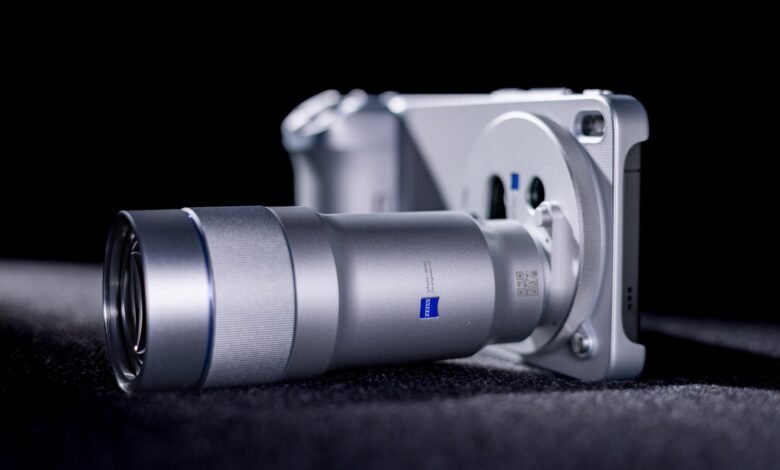
One of the most distinctive additions is the second-generation telephoto extender accessory. With it, the phone can reach an equivalent of 400mm, pushing the X300 Ultra closer to a professional camera experience when photographing faraway subjects.
That capability makes it relevant for situations such as wildlife or sports photography, especially when lighting conditions are favorable. In low light, image quality drops somewhat at the longest telephoto reach, although the results still remain sharp and detailed when the light holds up.
Vivo also provides a shooting grip to complement the setup. Combined with the teleconverter, the device is said to feel more like a professional camera than a regular phone.
Zeiss tuning and street photography focus
Vivo says one of the key strengths of the X300 Ultra is consistency across the camera system. The transition from the 14mm ultrawide to the 35mm main camera and then to the 85mm telephoto is designed to stay smooth, with uniform color character throughout.
That consistency is reinforced by the collaboration with Zeiss. The partnership brings color profiles such as Vivid, Soft, and Natural.
Vivo also gives special attention to street photography through Street Photography mode, formerly known as Humanistic Mode. The mode now includes film simulations with warm, cool, and classic tones.
The result is a more authentic look, with less aggressive AI intervention than the standard photo mode. At the front, the Vivo X300 Ultra carries a 50MP selfie camera with a roughly 24mm field of view.
In the end, the X300 Ultra is not just another high-spec flagship. With a 35mm main camera at the center of its system, Vivo is trying to shift mobile photography toward a different standard.