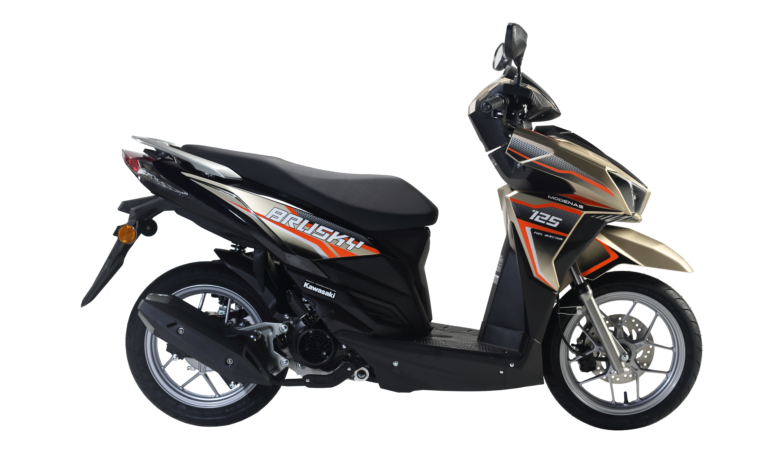
Kawasaki has stepped into Indonesia’s daily scooter market with the Brusky 125, a move that immediately draws attention in a segment long dominated by Honda and Yamaha. The model is positioned as Kawasaki’s first officially sold scooter in the country.
The timing makes the launch more notable because the 125cc class remains one of the biggest two-wheeler markets in Indonesia. For buyers, the Brusky 125 adds a new option from a brand that has usually been associated with sport, trail, and adventure motorcycles.
Price puts it straight into a crowded battleground
One of the strongest talking points is the price. Several automotive media reports place the Brusky 125 at around Rp26.5 million in certain regions, which puts it directly against popular Honda and Yamaha scooters in the same class.
That positioning matters because the competition is not only about pricing. Honda and Yamaha already have a major advantage through wide service networks, spare parts availability, and a large existing user base.
Built as a commuter, not a performance model
The Brusky 125 is clearly aimed at practical urban use. Kawasaki gives it a modern, sporty design with sharp body lines and a slim silhouette that suits city riding.
Some observers see similarities with several well-known scooters in Southeast Asia, although Kawasaki still adds its own visual identity through body details and color choices. The product direction is straightforward: comfort, efficiency, and ease of use for daily commuting.
Engine and drivetrain
Under the bodywork, the Brusky 125 uses a 125cc single-cylinder SOHC air-cooled engine with electronic fuel injection. Published specifications put output at around 9.3 to 9.6 hp at 7,500 rpm, while peak torque reaches 10 Nm at 6,000 rpm.
Power is sent through a CVT transmission, which supports smoother operation in dense traffic. The engine character is tuned more for efficiency than aggressive acceleration, making it suitable for office runs and routine city travel.
Features for everyday riding
Kawasaki equips the scooter with LED lighting for better night visibility and a more modern look. The instrument panel combines analog and digital elements, keeping the display simple but easy to read.
A USB charging port is also included, which adds practical value for riders who depend on smartphones while on the move. These are the kinds of features that matter most in the commuter scooter segment.
Suspension, brakes, and dimensions
The front end uses telescopic suspension, while the rear gets a monoshock setup. This combination is intended to help the scooter stay comfortable on uneven urban roads while keeping handling practical.
Braking is handled by a disc brake at the front and a drum brake at the rear, a common setup in entry-level scooters. The Bruksy 125 also has a seat height of about 760 mm and a curb weight of around 108 kilograms.
Those dimensions make it relatively approachable for a wide range of riders, including beginners moving up to a 125cc scooter. Its 5.1-liter fuel tank is another useful point for everyday mobility, reducing the need for frequent fuel stops.
A new option, but a difficult road ahead
The arrival of the Brusky 125 gives Kawasaki a fresh entry into the mass-market scooter fight, and that alone is significant. The brand already has loyal fans in Indonesia, so the scooter broadens its appeal beyond sport and adventure products.
Still, the challenge is clear. To gain a real foothold in the segment, Kawasaki will need to match not just product expectations but also after-sales support and parts availability, two areas where the market leaders remain firmly ahead.
If those pieces fall into place, the Brusky 125 could become a serious new name in the entry-level scooter class. For now, it stands out as Kawasaki’s most direct attempt to challenge the everyday scooter hierarchy on familiar ground.