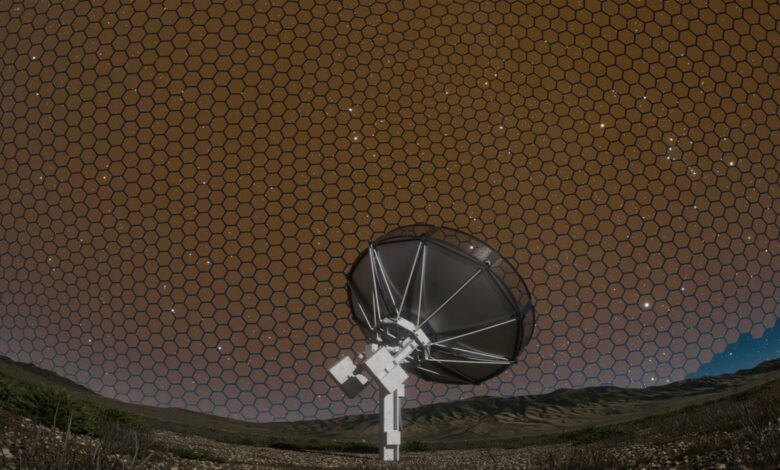
Caltech is preparing a radio telescope project that could change how astronomers survey the universe. The Deep Synoptic Array, or DSA, is being designed to scan the sky at extraordinary speed while also reaching a level of sensitivity that would make it one of the most capable radio instruments ever built.
The project is planned for a remote valley in Nevada’s desert, far from human-made radio interference. That location matters because radio pollution can distort astronomical observations and reduce the quality of the data collected by telescopes.
A Vast Antenna Network
When construction is complete in 2029, DSA is expected to consist of about 1,650 radio antennas. Each dish will measure nearly six meters across, and the full array will be spread over an area of roughly 19 kilometers by 16 kilometers.
That scale puts it far beyond the Very Large Array in New Mexico, which has only 27 antennas. By combining signals from many antennas, the system will operate like a single giant telescope and should capture finer detail from distant objects.
Why Astronomers Are Paying Attention
Gregg Hallinan, the project’s lead researcher, says the telescope will map the entire observable sky several times within its first five years of operation. He noted that no radio astronomy survey has reached that pace before.
Hallinan also described the expected jump in discovery power as dramatic. He said radio telescopes around the world have collectively found about 20 million radio sources so far, while DSA is expected to reach that number on its first day alone.
By the end of the initial survey, the telescope is projected to identify about 1 billion new radio sources. That would give astronomers an unusually large dataset for studying the structure and evolution of the universe.
Searching for Fast Radio Bursts and Dark Energy
Beyond large-scale mapping, DSA is also intended to investigate fast radio bursts, or FRBs. These are extremely energetic radio flashes that appear for only a brief moment, and their origins remain unresolved.
The telescope is also expected to support research into dark energy, the cosmic component thought to influence the expansion rate of the universe. That makes DSA relevant not only for cataloging objects, but also for probing some of the biggest questions in modern astronomy.
Fast Data and Open Access
One of the system’s most important strengths is near real-time data delivery. Researchers will be able to begin analysis immediately after observations are collected, without waiting through a long processing delay.
The development team also plans to make the observations publicly available from the start of operations. That approach would allow the data to serve both the scientific community and a wider public audience interested in seeing the sky mapped at this scale.
If construction and deployment proceed as planned, the Deep Synoptic Array could become one of the most influential astronomy instruments of the next decade. Its combination of rapid sky coverage, high sensitivity, and massive output may open a new window on radio sources, FRBs, and the mysteries of cosmic expansion.