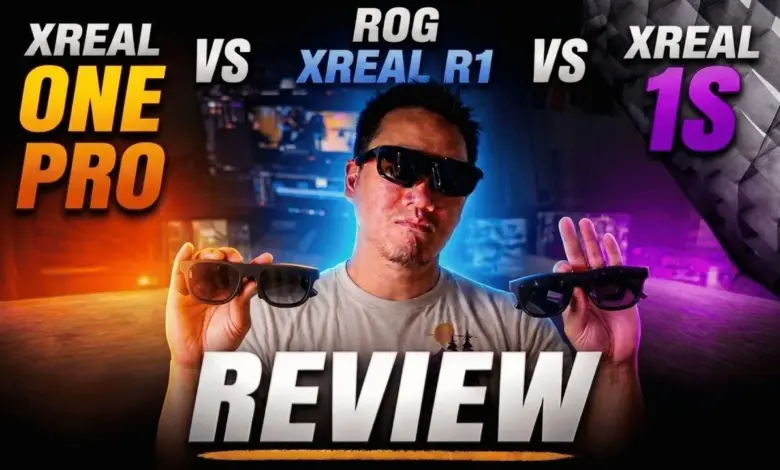
Choosing among XREAL’s latest AR glasses is no longer a simple matter of picking the newest model. The real decision now comes down to what matters most: smoother gaming, sharper text, or a more balanced all-around experience.
XREAL R1, XREAL One Pro, and XREAL 1S each take a different path. R1 pushes performance and connectivity, 1S focuses on display sharpness, and One Pro sits in the middle for buyers who want fewer compromises.
240Hz is the headline, but it comes with a cost
XREAL R1 is the most gaming-focused option in the lineup thanks to its 240Hz frame rate boost mode. The feature is designed to make motion feel smoother and more responsive during play.
That speed does not come for free. When 240Hz is enabled, vertical resolution drops to 1920 x 540p per eye, so users give up detail in exchange for fluid movement.
R1 also depends on compatible hardware to take full advantage of the mode. Gaming PCs and consoles are among the devices most relevant to that use case.
Its RG Control Dock extends connectivity to consoles, PCs, and streaming platforms, although some on-glasses controls become inactive when the dock is in use.
XREAL 1S is the sharpest option for text and detail
For users who care most about image clarity, XREAL 1S stands out. It uses a 1200p micro-OLED display, giving it more detail than XREAL R1 and One Pro, which both sit at 1080p.
That extra resolution matters in tasks that depend on precision. Coding, document editing, and detailed design work are the clearest beneficiaries of the 1S panel.
The trade-off is field of view. Compared with R1 and One Pro, XREAL 1S has a narrower viewing area, which makes it less immersive for games and movies.
Even so, for users who want crisp text and edge-to-edge precision, 1S is positioned as the strongest fit. It is the model most clearly aimed at productivity rather than pure entertainment.
One Pro remains the middle-ground choice
XREAL One Pro does not chase the extremes of either side. It skips the R1’s 240Hz mode and the 1S’s 1200p panel, but it still offers a solid mix of features for general use.
It shares 1080p resolution with R1 and keeps a wider field of view than 1S, which helps preserve a more open visual experience. That makes it appealing to buyers who want broad usability without narrowing their priorities too far.
In practical terms, One Pro is the option for users who want to enter the XREAL ecosystem without aiming for the most specialized feature set. It is framed as a model that balances performance and affordability.
Extra visual tools set R1 apart
R1 also has one feature not found on One Pro or 1S: real-time color calibration. Users can adjust contrast, saturation, and color balance directly to match their preferences.
That makes the headset appealing not only to gamers, but also to professionals who want more precise visual tuning. Graphic designers and video editors are the most likely to use that flexibility.
R1 is also described as having improved edge clarity over One Pro thanks to a smaller prism design. Even with that advantage, 1S is still presented as the model with the best overall clarity in the lineup.
All three models now support instant 3D mode. The feature converts 2D content into 3D in real time, although the result depends heavily on correct interpupillary distance, or IPD, alignment.
If IPD is not properly adjusted, the 3D effect weakens. In other words, the feature relies as much on user setup as it does on the hardware itself.
Audio, design, and comfort stay broadly similar
Audio performance is relatively even across the three models. The built-in speakers are considered clear enough for casual media viewing and gaming, though users who want higher-quality sound will still be better served by external headphones.
Design and ergonomics are also tuned for long sessions on all three devices. R1 has a more compact and sporty look, which may appeal to users who value portability and style.
Comfort levels remain broadly comparable across the range. That makes each model suitable for extended work, gaming, or movie sessions without a major difference in wearability.
Which model is worth buying?
Price reflects each model’s focus. XREAL R1 sits higher in the range because it includes the RG Control Dock and 240Hz mode, but that extra value only matters if those specific features are actually needed.
XREAL 1S offers strong value for users centered on productivity and visual precision. XREAL One Pro remains the more economical route for general use, with a feature set that avoids too many compromises.
For buyers, the decision comes down to one question: whether smooth 240Hz motion, 1200p micro-OLED clarity, or a more balanced everyday package matters most.