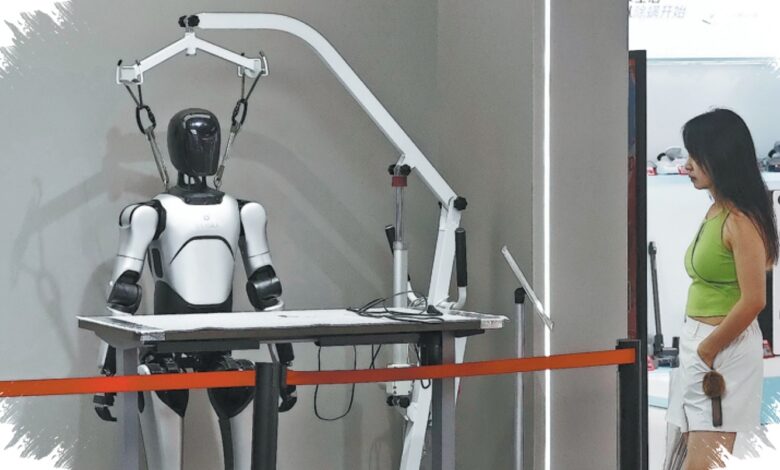
China’s push to develop humanoid robots is increasingly focused on a component that appears deceptively familiar: the hand. A robot may run or dance, but it remains far from broadly useful if it cannot handle ordinary objects with human-like control.
Tying shoelaces, fastening buttons and cracking an egg are among the tasks that remain difficult for machines. Each requires a robot to regulate force, detect contact and continuously adjust individual finger movements.
A Fast-Growing Industry Around a Difficult Problem
Despite the technical barriers, China is expanding investment in dextrous hand technology, designed to give robots greater manipulation skills. Reported industry figures show sharp growth in both market value and the number of registered robotics companies.
| Indicator | 2024 | 2025 |
|---|---|---|
| Dextrous hand industry value | 13 billion yuan | More than 50 billion yuan |
| Registered robotics companies | Previous-year baseline | Up about 40 percent |
The value of China’s dextrous hand industry reportedly rose from 13 billion yuan in 2024 to more than 50 billion yuan in 2025. The number of registered robotics companies was also reported to have increased by about 40 percent from the previous year.
The figures underline the importance attached to robot hands as developers seek to make humanoid machines more useful outside controlled demonstrations. The goal is not simply to build a hand that closes around an object, but one that can respond correctly to its physical properties.
Why Hands Are So Hard to Replicate
Human hands work through the simultaneous coordination of nerves, muscles and dozens of joints. People can alter finger position and pressure almost automatically while responding to an object’s texture, shape and resistance.
When tying a shoelace, a person modifies their grip while sensing the flexible cord. When cracking an egg, the hand applies enough pressure to break the shell while protecting the contents.
Robots do not possess human nerves or an innate understanding of the physical world. They must therefore be engineered and programmed to sense contact, measure pressure and react when the object being held changes condition.
Tesla CEO Elon Musk has previously said that much of the engineering challenge in robotics lies in the hand. The observation highlights the gap between robots with advanced body movement and humanoid robots that can reliably manipulate everyday items.
LinkerBot Sees a Larger Barrier
Zhou Yong, founder of LinkerBot, which develops robot hands, has described the task as 100 times harder than building a humanoid robot. As quoted by The Guardian, Zhou said that focusing on hands could make it easier to reproduce many human abilities.
The central challenge is handling fragile, flexible and varied objects with precision. Until that capability becomes dependable, humanoid robots will remain more prominent as technology demonstrations than as practical working tools.